Key Takeaways
- The right therapist software depends on one question: do you bill insurance? If yes, you need an EHR (SimplePractice, TherapyNotes). If no, you need something lighter.
- Private-pay therapists commonly overpay for clinical features they never use — insurance billing, clinical notes, HIPAA telehealth — because that's what most therapy software is built for.
- The features a private-pay therapist actually needs: booking, payment, cancellation enforcement, a professional practice page, and optional course hosting.
- SimplePractice is the best choice for insurance-billing therapists. Merkora is the best choice for private-pay therapists who don't need clinical documentation.
- Most therapists are using either too much (full EHR) or too little (just Calendly). The right tool sits between those extremes.
In this article
Search "best therapist software" and you'll get a dozen listicles that recommend the same five tools, all of which pay for placement. What you won't get is an honest answer to the question that actually matters: which one is right for your practice?
The answer depends almost entirely on what you need. A solo therapist in private practice who sees 15 clients a week and wants a professional online presence has completely different needs from a group practice with insurance billing and clinical notes. Most comparison posts ignore this distinction entirely.
This one doesn't. Here's an honest look at five tools — what each does well, where it falls short, and who it's actually built for.
What therapists in private practice actually need
Before comparing tools, it's worth being specific about the use case. Private practice therapists — solo operators, no insurance billing, self-referred clients — need a different set of features than a clinical group practice.
The core requirements for a solo private practice:
- Online booking that clients can use without phoning you
- Payment collection at the point of booking — not invoiced after
- A cancellation policy that enforces itself
- Intake forms collected before the first session
- A professional public page that explains who you are and what you offer
- Automated reminders to reduce no-shows
Notice what's not on that list: insurance billing, clinical notes, HIPAA compliance dashboards, team management. Those features matter for group practices and insurance-accepting clinicians — but they add complexity and cost that most solo private practice therapists don't need and won't use.
Keep that distinction in mind as you read through the tools below.
SimplePractice — best for insurance-accepting practices
SimplePractice is the most well-known therapist-specific platform, and for good reason: it's a genuinely comprehensive EHR (Electronic Health Record) system. It handles insurance billing, clinical notes, treatment plans, client portal, telehealth, and scheduling — all in one place.
If you accept insurance and need to manage clinical documentation, SimplePractice is one of the better options in the market. It was built specifically for therapists and other mental health practitioners, and the depth of its clinical features shows.
Where it falls short for solo private practice: It's expensive ($69–$99/month depending on plan) and that cost is justified by clinical features most private practice therapists don't need. More importantly, it has no public-facing practice page — clients find you elsewhere and then get directed to a client portal. There's no course or digital product delivery. If you want to build a professional online presence alongside your practice, SimplePractice doesn't do that.
Best for: Therapists who accept insurance, need clinical notes, or work in a group practice context. Overkill — and overpriced — for cash-pay solo private practice.
Acuity Scheduling — best scheduling-only option
Acuity (now owned by Squarespace) is a step up from Calendly for therapists. It handles intake forms attached to specific appointment types, payment collection and deposits, packages and subscriptions, and coupons — all things Calendly's standard plans don't support natively.
For a therapist who primarily needs robust booking and nothing else, Acuity is a reasonable choice. The intake forms are genuinely usable — you can build multi-question forms that are sent automatically when a specific appointment type is booked.
Where it falls short: It's still fundamentally a scheduling tool. There's no client history or record — each booking is isolated. There's no professional practice page; clients land on a scheduling widget, not a page that represents your practice. There's no course or content delivery. And the cancellation policy enforcement is manual — Acuity tells you someone cancelled, but enforcing a late cancellation charge is still your conversation to have.
Best for: Therapists who need better booking than Calendly and nothing else. Often used as part of a larger stack alongside a separate website, Zoom, and another tool for content.
Calendly — where most therapists start (and outgrow)
Calendly is the default starting point for most practitioners setting up online booking. It's free, it works, and it solves the back-and-forth scheduling problem immediately. The paid plans add payment collection and some basic form fields.
The problem is that Calendly was built for scheduling internal meetings, not for running a therapy practice. It has no intake forms worth using clinically, no cancellation policy enforcement, no client records, no professional practice page, and no content delivery. We've covered this in detail in our post on therapist software vs Calendly.
Best for: Getting started. Most therapists find they've outgrown it within six months of building a real client base.
Kajabi — best for course-heavy practices
Kajabi is a course and digital product platform that has added coaching and scheduling features over time. If the majority of your revenue comes from online courses, group programs, or digital products — and booking is secondary — Kajabi is a powerful option.
The course builder is genuinely excellent. Video hosting, structured modules, progress tracking, community features — if you're building a significant content business alongside your practice, Kajabi handles it well.
Where it falls short: It's expensive ($150–$400/month) and the booking and practice management features are clearly secondary to the content features. There's no real cancellation policy enforcement, no credit system, and the scheduling experience is less polished than tools built around it. It also has an influencer/creator aesthetic that doesn't always suit therapists who want to look professional rather than promotional.
Best for: Therapists who are primarily course creators or content businesses with a side of 1-on-1 work. Not ideal as the primary practice management tool.
Merkora — best therapist software for all-in-one private practice
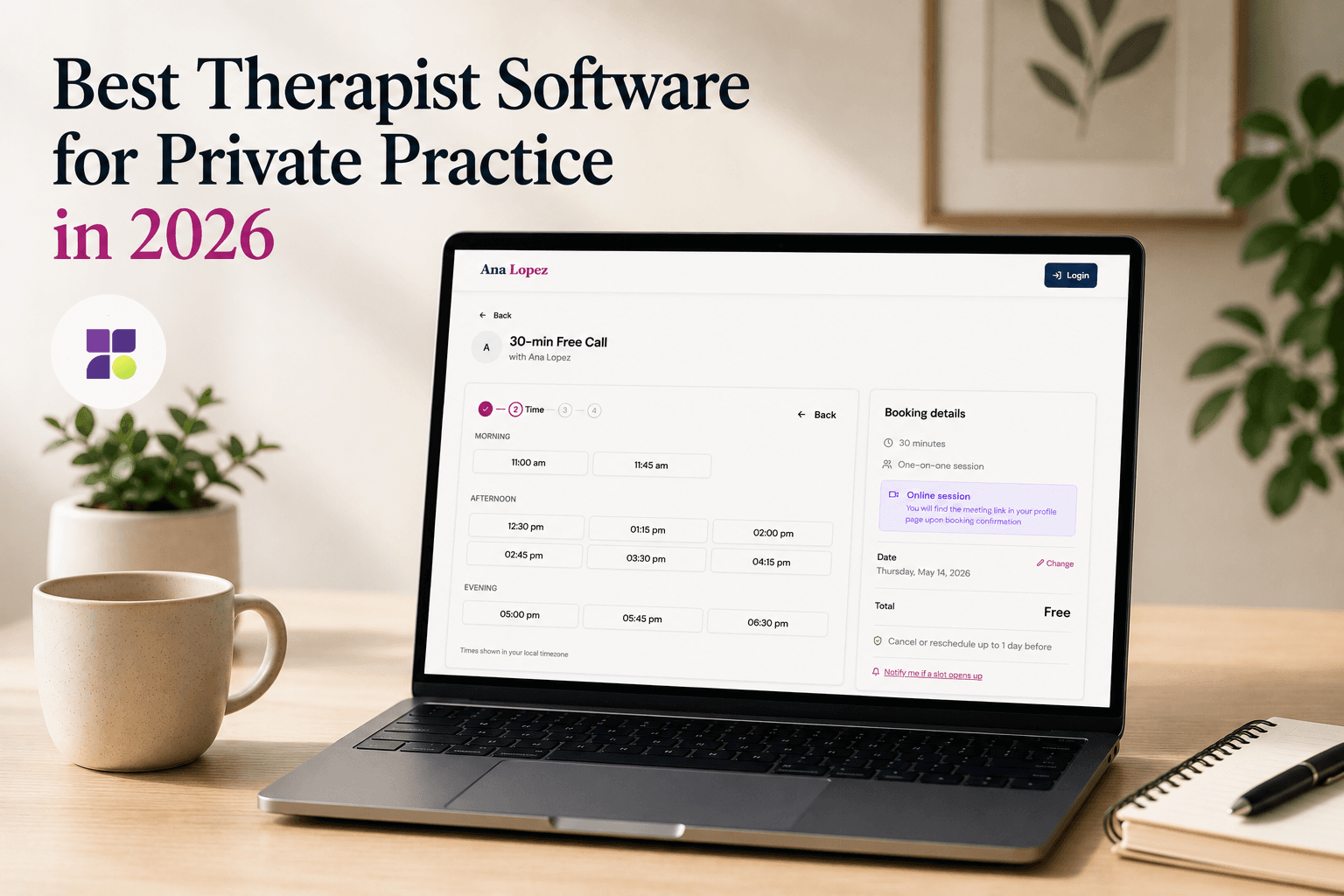
Merkora was built specifically for the use case most of the tools above weren't designed for: a solo therapist or coach in private practice who wants one professional page that handles everything — booking, cancellation policy, intake forms, courses, digital products, and client history — without clinical EHR features they don't need and without paying for three separate tools.
The core of the platform is a professional practice page — a single URL that shows who you are, what you offer, what clients say about you, and lets them book, enroll in a course, or download a resource without leaving. Booking comes with a built-in cancellation policy, deposit collection, automatic reminders, and a credit system for late cancellations. Intake forms are attached to specific service types and stored with the client's record.
It's currently in early access — if you're setting up your practice and want to try it, the waitlist is open at merkora.app.
Where it's still growing: As a newer platform, it doesn't have the years of polish that SimplePractice or Acuity have built up. If you need insurance billing, clinical notes, or HIPAA-compliant documentation, it's not the right fit — and it doesn't try to be.
Best for: Solo therapists in cash-pay private practice who want a professional online presence, solid booking with real cancellation policy enforcement, and the ability to add courses or digital products without switching platforms.
Which is the best therapist software for your practice?
The honest answer depends on one question: do you need clinical documentation and insurance billing, or do you need a professional online presence with solid practice management?
If you accept insurance and need clinical notes — SimplePractice is the most complete option despite the cost.
If you just need better booking than Calendly and plan to manage everything else separately — Acuity is a reasonable fit.
If you're a cash-pay solo practice and want one platform that handles your public page, booking, cancellation policy, courses, and client records without the clinical overhead — Merkora was built for exactly that.
If courses and digital products are your primary business and booking is secondary —Kajabi is worth the cost.
If you're just starting out and not sure — Calendly works for now, but plan to outgrow it.
The tool that's best for you is the one that covers your actual needs without charging you for features you'll never use. For most solo private practice therapists, that means therapist software built around the practice page and client relationship — not around clinical documentation or content creation. Once you've chosen a platform, our guide on how to set up online booking for your therapy practice walks through the full configuration — availability, intake forms, cancellation policy, and reminders — in a single afternoon.
Frequently asked questions
What is the best software for therapists in private practice?
If you bill insurance: SimplePractice or TherapyNotes. If you're private-pay only: Merkora or Acuity Scheduling. The distinction matters because insurance-billing therapists need clinical documentation and claim submission — private-pay therapists don't and shouldn't pay for it.
Does a private practice therapist need HIPAA-compliant software?
If you handle protected health information (PHI) — session notes, diagnoses, treatment plans — yes. Most video and email platforms offer a Business Associate Agreement (BAA). For booking and payment, HIPAA compliance is good practice. Merkora follows data security best practices for private-pay practices.
Is SimplePractice worth it for a solo therapist?
If you bill insurance, yes — the billing workflow and clinical documentation are worth the $29–$99/month. If you're private-pay only, you're paying for insurance billing you don't use. A lighter platform is more cost-effective.
Can therapists use Kajabi?
Kajabi works if you sell courses and have a large content business. For session-based practices, it's expensive ($149+/month) and its session booking features are basic — no automatic cancellation enforcement, no credit system. Better for content creators than practitioners.