
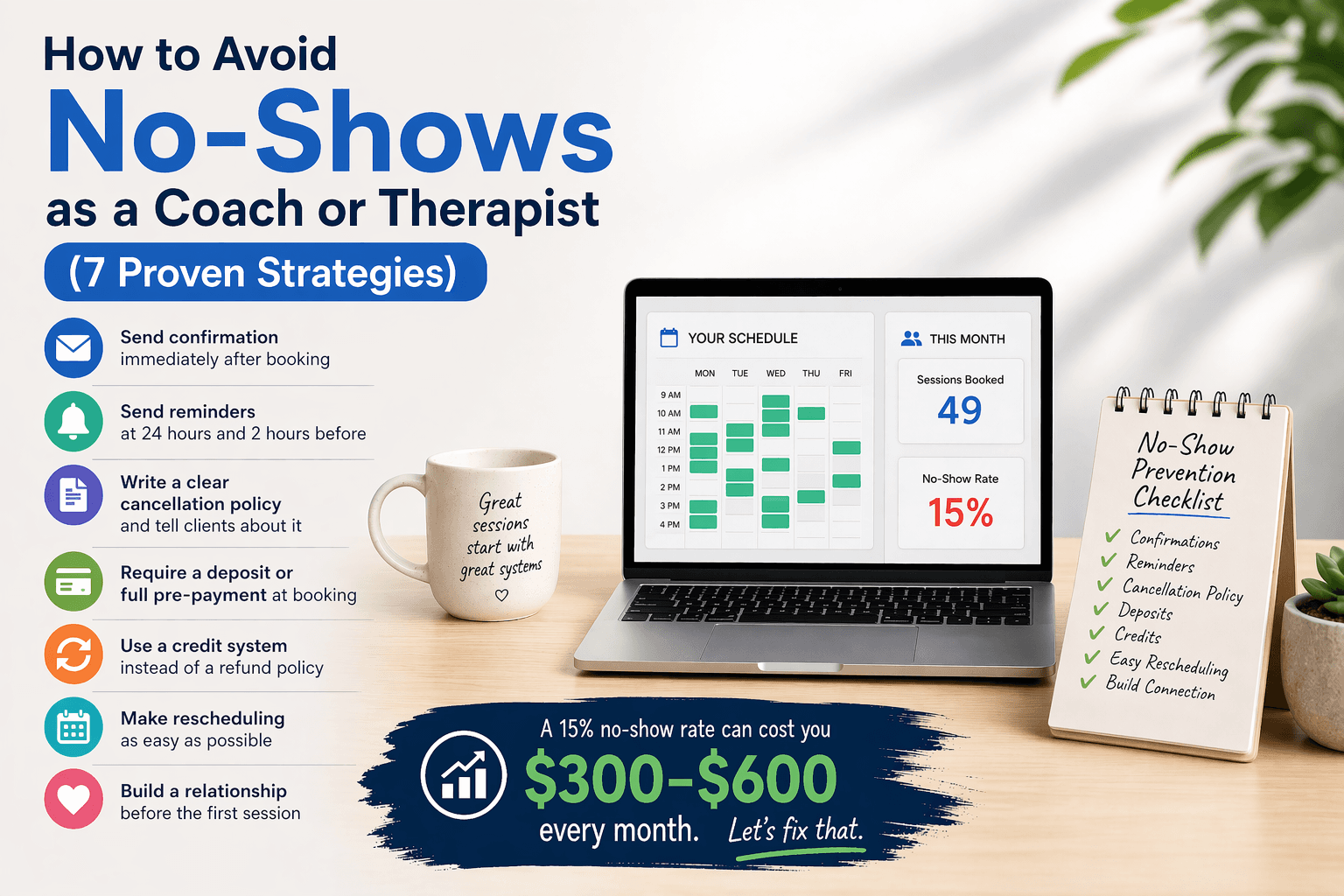
A coach or therapist with a full schedule and a 15% no-show rate is quietly losing $300–$600 every month. That's not a rounding error — it's a real operating problem that compounds over time. You lose the session fee, you lose the slot you could have offered someone else, and you spend mental energy chasing people down.
The good news: no-shows are almost entirely preventable. Not with willpower or awkward conversations — with the right systems in place before the session ever happens.
Here are seven strategies that work, ordered from easiest to implement to most impactful over time.
1. Send a confirmation immediately after booking
The moment a client books a session, they should receive a confirmation with the date, time, timezone, and a link to reschedule or cancel. This does two things: it reassures the client the booking went through, and it sets the expectation that managing the appointment is their responsibility.
A booking system that sends this automatically removes one of the biggest causes of no-shows: the client who "forgot they even booked." Without a confirmation in their inbox, it's remarkably easy for a session to slip out of someone's memory entirely — especially if they booked two weeks in advance.
2. Send reminders at 24 hours and 2 hours before
One confirmation email is not enough. The research on appointment adherence is consistent: two reminders — at 24 hours and 2 hours before — reduce no-shows significantly compared to a single reminder. The 24-hour reminder gives clients time to reschedule if something came up. The 2-hour reminder catches the people who genuinely forgot.
Both messages should include a clear, one-click reschedule link. The goal isn't just to remind — it's to make it easier to reschedule than to simply not show up. When rescheduling is frictionless, clients use it instead of ghosting you.
3. Write a clear cancellation policy — and tell clients about it
Most coaches and therapists have an informal cancellation policy they mention awkwardly at the end of a first session, or bury in a PDF nobody reads. That's not a policy. That's a hope.
A real cancellation policy is:
- Written down in plain language
- Shared with every client before their first session
- Consistent — applied the same way every time
- Specific about the notice window (e.g., "less than 24 hours = full fee applies")
Common effective policies are 24-hour or 48-hour notice requirements. Anything cancelled with less notice than that counts as a late cancellation and the full (or partial) session fee applies. The key is that clients know this in advance — then it's not a confrontation, it's just how you work.
4. Require a deposit or full pre-payment at booking
This is the single most effective no-show prevention measure. When a client has already paid for a session, they are far more likely to show up — or to give proper notice if they can't. A financial commitment changes behavior in a way that a confirmation email never will.
You don't have to require 100% upfront. Even a 25–50% deposit is significantly more effective than no deposit. For practitioners working with new clients or offering free discovery calls, a credit card on file (with a clear late cancellation charge) achieves a similar result.
Many coaches worry this will deter clients. In practice, serious clients — the ones you actually want — expect this level of professionalism. It's standard in other professional services. The clients who disappear when asked for a deposit were likely to no-show anyway.
5. Use a credit system instead of a refund policy
Rather than offering cash refunds for late cancellations (which creates a perverse incentive — clients learn they can cancel without real consequence), convert the session fee into a credit that can only be used toward a future booking with you.
This approach handles the most common no-show conversation gracefully: the client who cancels last-minute and asks for their money back. With a credit system, you honor their need for flexibility while protecting your time. They don't lose money, but they don't get a cash refund either — the value stays within your practice.
It also reduces the emotional difficulty of enforcing your cancellation policy. "I'll turn this into a credit you can use anytime" is a much easier conversation than "I'm keeping the fee."
6. Make rescheduling as easy as possible
Every barrier between a client and rescheduling is a step closer to a no-show. If rescheduling means sending an email, waiting for a reply, going back and forth on times, and then getting a calendar invite — many clients will just not bother. They'll tell themselves they'll do it later, and later becomes never.
The solution is self-service rescheduling: a link in every reminder email that takes the client directly to a calendar where they can pick a new time without any back-and-forth. You want it to feel as easy as rescheduling a restaurant reservation on OpenTable. When it is, clients use it.
7. Build a relationship before the first session
This is the oldest and least-talked-about no-show prevention strategy. Clients who feel a genuine connection — who know something about you, who have watched a short video or read your about page — are less likely to ghost you. It feels personal. There's a real relationship at stake.
For discovery calls especially, send a short personal message between booking and the session. Something that names what they said they're working on and expresses genuine interest. It takes two minutes and dramatically changes the dynamic from "anonymous calendar booking" to "someone is expecting me and prepared for me."
The tool question: what you actually need
All seven strategies above require a booking system that handles them automatically — otherwise you're managing confirmations, reminders, deposits, and credits manually, which defeats the point.
What to look for in a booking tool:
- Automated confirmation and reminder emails with reschedule links
- Built-in cancellation policy with configurable notice window
- Deposit or pre-payment support at the time of booking
- Credit system for handling late cancellations without cash refunds
- Self-service rescheduling for clients
Most popular scheduling tools (Calendly, Acuity, Cal.com) handle reminders and basic cancellation — but don't have a native credit system or deposit-to-credit conversion. That means you're still handling the awkward conversations manually.
If you're a therapist in private practice, we've also written a dedicated guide on how to set and enforce a no-show policy for your therapy practice — including the specific policy language and how to introduce it to existing clients without it feeling punitive.
Coaching software built for private practice handles all of this automatically. Merkora was built specifically for coaches and therapists and has everything in one place — cancellation policy, credit system, deposits, and automated reminders — alongside your full booking page, courses, and client history. It won't solve every no-show (nothing will), but the right systems get you most of the way there without extra conversations.
Summary: the no-show prevention checklist
- ✓ Automated confirmation email immediately after booking
- ✓ Reminder at 24 hours before (with reschedule link)
- ✓ Reminder at 2 hours before
- ✓ Written cancellation policy shared before first session
- ✓ Deposit or pre-payment required at booking
- ✓ Credits (not cash refunds) for late cancellations
- ✓ Self-service rescheduling link in every reminder
None of these strategies require you to become a harder, less empathetic practitioner. They just mean your business runs with the same professionalism your clients already expect from you.