Key Takeaways
- Start structuring a multi-week program from the transformation arc — where participants start and where they end — not from how many weeks feels reasonable.
- What happens between live sessions (a short task, a reflection prompt) does more for outcomes than the sessions themselves.
- Larger groups increase energy and revenue per program but reduce individual depth — the right size depends on which one the offer is actually selling.
- Price the program as one offer with one commitment, not as a bundle of discounted individual sessions.
- The most common structuring mistake is treating each week as a standalone topic instead of a sequence that builds.
In this article
The easiest way to build a multi-week program is to pick a number of weeks, assign one topic per week, and call it done. It's also the easiest way to end up with a program that feels like five disconnected workshops wearing a shared name.
A program that actually holds together starts somewhere else entirely — not with the schedule, but with the arc.
Start with the arc, not the schedule
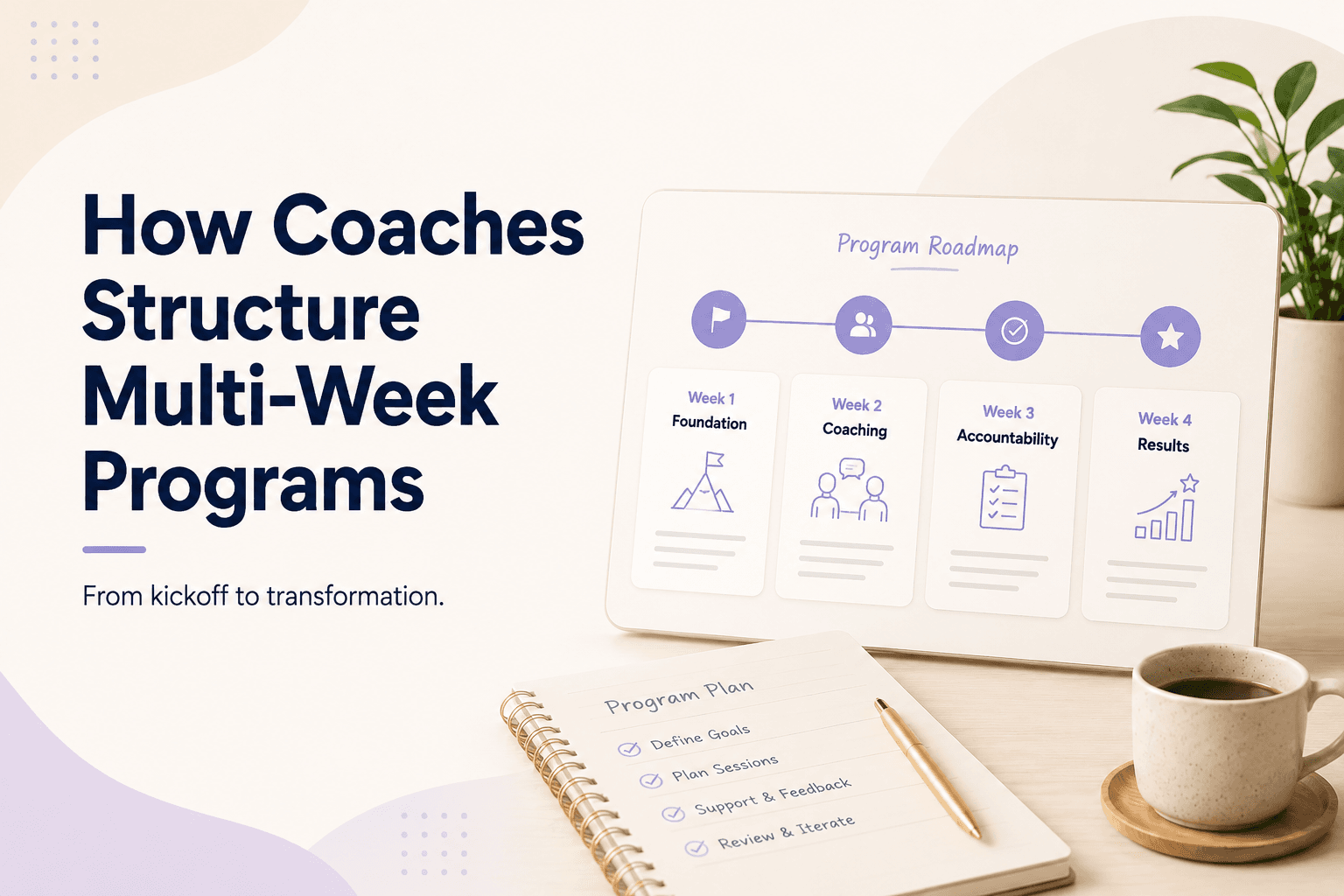
Before deciding how many weeks or what each week covers, define where a participant starts and where they should be by the final session. That single sentence — the honest before-and-after — is what every week should serve. Once it's clear, the number of weeks and the topic order tend to fall out naturally, instead of being guessed at first.
Programs built the other way around — schedule first, arc never defined — are the ones that feel like five separate calls. There's no throughline for participants to feel themselves moving along.
What happens between sessions matters more than the sessions
The live call is the visible part of a multi-week program. The work that happens between calls — a short task, a reflection question, a small experiment to try before the next session — is usually what actually produces the outcome participants paid for.
A program with strong live sessions and nothing in between them tends to underperform a program with lighter sessions and a clear, small between-week action. Live time is limited; the days between sessions aren't.
Group size and the trade-off with depth
Group size is a real design decision, not just a revenue lever. A smaller group (roughly 6-12) supports individual attention, everyone gets seen, and accountability is personal. A larger group trades that depth for energy, community feel, and higher revenue per program.
Neither is wrong — but the size has to match what the program is actually selling. A program marketed as intensive, individualized coaching doesn't work at 40 people. A program marketed as a shared learning experience can.
Pricing the program as one offer
The arc only holds together if the pricing reflects it. Price the program as a single offer with one commitment — not as five sessions someone can opt in and out of individually. This mirrors what makes the right platform for multi-week programs matter: registration, payment, and attendance all need to treat the program as one thing.
Key takeaway
Common structuring mistakes
- Building the schedule before defining the transformation
- Treating each week as a standalone topic instead of a building sequence
- No between-session task, so the live call carries all the weight
- Group size chosen for revenue instead of the depth the offer actually promises
- Pricing per session instead of pricing the program as one commitment
Getting the structure right matters more than the platform running it — but the two compound. Once the arc, the between-week work, and the pricing are sound, Merkora handles registration, live sessions, recordings, and attendance as one program, so the structure you designed is what participants actually experience.
Frequently asked questions
How many weeks should a multi-week program run?
Long enough for a real behavior or skill shift to happen, short enough that participants can see the finish line. Most effective programs run 4 to 8 weeks — under 4 rarely allows enough between-session practice, and over 8 tends to lose engagement without a very strong structure.
Should every week cover a different topic?
Not entirely. Programs that build — each week extending or applying the last — tend to outperform programs where each week is a self-contained topic. A sequence is more valuable than a series of unrelated lessons.
What size group works best for a multi-week program?
It depends on the goal. Smaller groups (6-12) allow real individual attention and stronger accountability. Larger groups (30+) work better when the value is primarily the content and community, with less expectation of individual coaching within the sessions.
How do I handle participants who fall behind?
Give them a way to catch up without holding the group back — access to prior recordings, a short async recap, or an optional office-hours slot. The live sessions should move forward on schedule regardless of individual pace.