
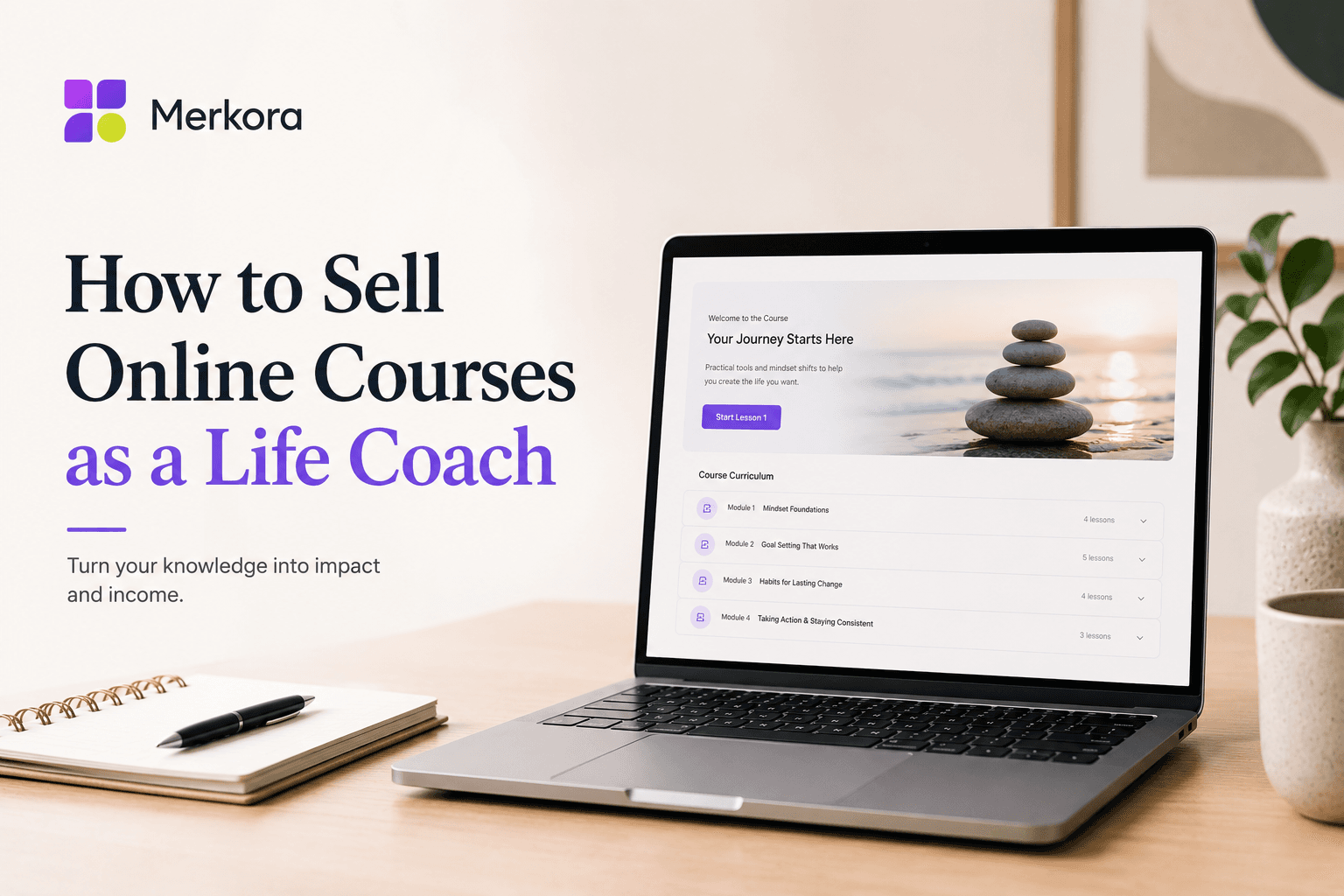
Most coaches have a list of clients somewhere — past and present — and if they look at their notes, they'll notice something. The same questions come up in nearly every discovery call. The same three or four topics consume the first month of most engagements. The same frameworks solve the same problems, over and over.
That pattern is the foundation of an online course. Every time a coach answers the same question for the fifth time, that's a module that could be recorded once and sold indefinitely. Coaches who see this build a second income stream alongside their 1-on-1 work — one that earns without their time, reaches clients who can't afford weekly sessions, and scales without a ceiling.
Here's how to sell online courses as a life coach: what to build, how to price it, and how to get it in front of the right people.
Why 1:1 coaching has a built-in revenue ceiling
A coach with 20 active clients at $150 a session, two sessions per client per month, earns $6,000 a month. That's a real, full practice. The problem: adding a 21st client means finding more time. There's no 22nd slot without dropping someone, extending your week, or raising prices significantly.
This is the ceiling that courses solve. A course you build once can be sold to 5 clients or 500 — the delivery cost is the same either way. It doesn't take an hour of your time per buyer. And it lets people who want to learn from you but can't afford weekly sessions access your methodology at a lower price point, which expands your audience rather than cannibalising your existing client base.
Coaches who add courses rarely replace their 1:1 work — they build alongside it. Course buyers become 1:1 clients once they've seen how you work and want more. 1:1 clients go deeper, faster, because they arrived with the foundation already in place.
What separates courses that sell from courses that don't
Courses that don't sell are usually built the wrong way around: the coach decides what they want to teach, builds it, then looks for buyers. Courses that sell are built around a specific, named outcome that a specific, identifiable person is actively looking for.
The difference looks like this:
- "A coaching course about mindset" — too broad, no clear buyer
- "A 6-week program for coaches at $3–5K/month who want to reach $10K without working more hours" — specific, the buyer knows immediately whether it's for them
Specificity sells. The more precisely you can name the person this course is for and the outcome they'll get from it, the easier it is to sell — because the right buyers self-select in and the wrong buyers self-select out before you've spent time or money on them.
Start with what your 1:1 clients already pay you for
The most reliable source for a course topic is your current client work. Look at your notes from the past year and ask: what do almost all of my clients want to work on in the first month? What's the framework I explain so often I could deliver it in my sleep? What problem brings people to me again and again?
That's your first course — and the advantage of building from existing client work is that you already know the topic is valuable because people have paid you to address it directly. You're not guessing at what a course buyer might find useful. You've lived it with real clients.
Three approaches worth considering:
- The accelerated start. Take the first month of your typical 1:1 engagement — the orientation, the core frameworks, the foundation you build with every client — and teach it as a standalone course. Clients who complete it first arrive at 1:1 sessions three weeks ahead. For buyers who can't afford 1:1 work, it's a complete foundation on its own.
- The common problem. What's the thing most clients are stuck on when they find you? That specific sticking point — "how to stop second-guessing yourself," "how to build a client base from zero," "how to stop people-pleasing at work" — is a high-value course topic. These are problems people know they have and are actively searching for answers to.
- The transformation arc. Map the 8-week journey most clients go on with you, structure it, record it. This is usually the most comprehensive and highest-priced option — and it's essentially the group version of your standard engagement.
Choosing a price for your coaching course
This is where most coaches underprice — either because they don't feel confident, or because they're comparing to mass-market courses on Udemy or Skillshare. Don't. Life coaching courses serve a motivated buyer looking for a real outcome. They are not competing with $15 courses. Price them accordingly.
A rough framework:
- $97–$297 — Entry-level or focused module. A specific topic that solves one problem or teaches one skill. Designed for buyers who want to experience your work before committing to a full program or 1:1 sessions.
- $297–$997 — Full course.A 4–8 week program with a clear transformation arc. Price toward the higher end if you include live Q&A calls or community access.
- $997–$3,000+ — Course plus coaching hybrid. A self-paced or cohort course paired with group coaching calls or limited 1:1 access. The live component justifies the premium. This is where most of the real revenue is in coaching courses.
The question to ask before setting a price: what is the outcome of this course worth to someone who takes it seriously and implements it? If the answer is "potentially $20,000 in new income over the next year" — a $497 course is a bargain, not a luxury. Price from the value of the outcome, not from what it cost you to produce.
How to sell online courses as a life coach
The most common mistake coaches make with their first course: build it entirely, then figure out how to sell it. The better approach is to validate before you build, or at minimum sell to a small group before recording every module. If nobody buys the concept, you haven't wasted months of production time.
To your existing clients first. Your current and past clients already know you, trust you, and have seen results from working with you. They are the easiest people to sell to. A personal email explaining what you're building and offering a founding-member rate is often enough to get the first 5–10 buyers. This validates the topic, covers your time to build it, and generates the testimonials you need to sell the next cohort.
As a follow-up to discovery calls that don't convert. Not every discovery call ends in a 1:1 engagement — because of budget, timing, or fit. A course at $197–$497 is a natural follow-up for someone who wants to work with you but isn't ready for the full commitment. "Based on what you shared, this course covers exactly what you're working on — at a fraction of the cost of 1:1 work" is a genuine offer, not a consolation prize. It also means a discovery call that doesn't convert to 1:1 work isn't wasted. (If no-shows and last-minute cancellations are cutting into your discovery call capacity, that's a separate problem worth fixing first.)
Through referrals from satisfied clients. A course at an accessible price point that a client can recommend to a friend — without sending them into a full-priced 1:1 engagement — is a natural referral path. "I can't afford to work with her directly right now, but she has a course that covers exactly this" is a real conversation your clients have. Make sure they have something to point to.
Through your content, consistently. If you publish anything — Instagram, LinkedIn, a newsletter — your course should be visible there on a regular basis. Not every post needs to be a sales push, but every post should be coherent with the problem your course solves. When someone reads three of your posts and recognises themselves in the problem you keep writing about, the course becomes the obvious next step. It sells itself when you're consistent — not because you found the perfect launch moment.
How to structure a course clients actually complete
Completion rates matter — for client outcomes and for the testimonials you need to sell the next cohort. A course nobody finishes generates neither.
The structure that gets completed: short modules (10–20 minutes per lesson), one clear action per module, and regular progress checkpoints. Long video lectures with no exercises are where courses go to die.
A practical template for a 6–8 module course:
- Module 1 — Foundation. Establish the problem clearly. Help clients understand exactly where they currently are. This module builds commitment and filters out people who aren't genuinely ready to engage.
- Modules 2–4 — The core shift. The main frameworks, tools, and concepts — one per module, each building on the previous one, each ending with a specific exercise.
- Modules 5–6 — Application. How to put the frameworks into practice in the client's specific context. This is where general concepts become personal.
- Module 7 — Consolidation and next steps. What to do now, how to sustain progress, what to do if they get stuck. This module significantly improves long-term results and generates better testimonials.
Keep it to 6–8 modules for most topics. The temptation is to add more — more content, more value, more modules. Resist it. A shorter course that gets completed and delivers a clear result is worth more than a comprehensive course nobody finishes.
Where your course lives — and why it matters for sales
A course that requires clients to leave your main page, navigate to a separate platform, create a new account, and re-enter their payment details has unnecessary friction at every step — and every step is a drop-off point.
The ideal setup: your course is visible on the same page where people can also book a 1:1 session with you. A visitor who finds you through a referral or your content can, in a single visit, read about who you are, see your session offerings, and buy your course without being redirected to Teachable or a separate Gumroad page. When everything is in one place, cross-selling happens naturally and clients don't have to piece your business together from multiple platforms.
This is one of the core arguments for coaching software that handles booking and courses together, rather than managing them on separate tools. If you're already thinking about how to run your coaching business from one link, adding a course to the same page is far simpler than maintaining a separate platform for it.
The mistake that kills course momentum
Most coaches who build a course once and never sell it again made the same mistake: they launched, promoted it for a week, didn't get the response they hoped for, and concluded that the topic didn't work.
The topic almost never doesn't work. The promotion stopped working because it stopped.
Courses compound when they're on sale consistently — in every relevant piece of content you produce, in every discovery call follow-up, in every client recommendation. The coaches who build real course income treat their course like a permanent offering, not a launch event. It's always available. It's always mentioned. The work is to keep making it visible, not to find the perfect moment to push it.
Merkora was built for coaches who want their courses and their 1:1 bookings on the same page — so a potential client who finds you can see everything you offer in one place, and buy without being redirected somewhere else. If you're adding a course to your practice and want it to live alongside your other offerings, it's worth a look.