
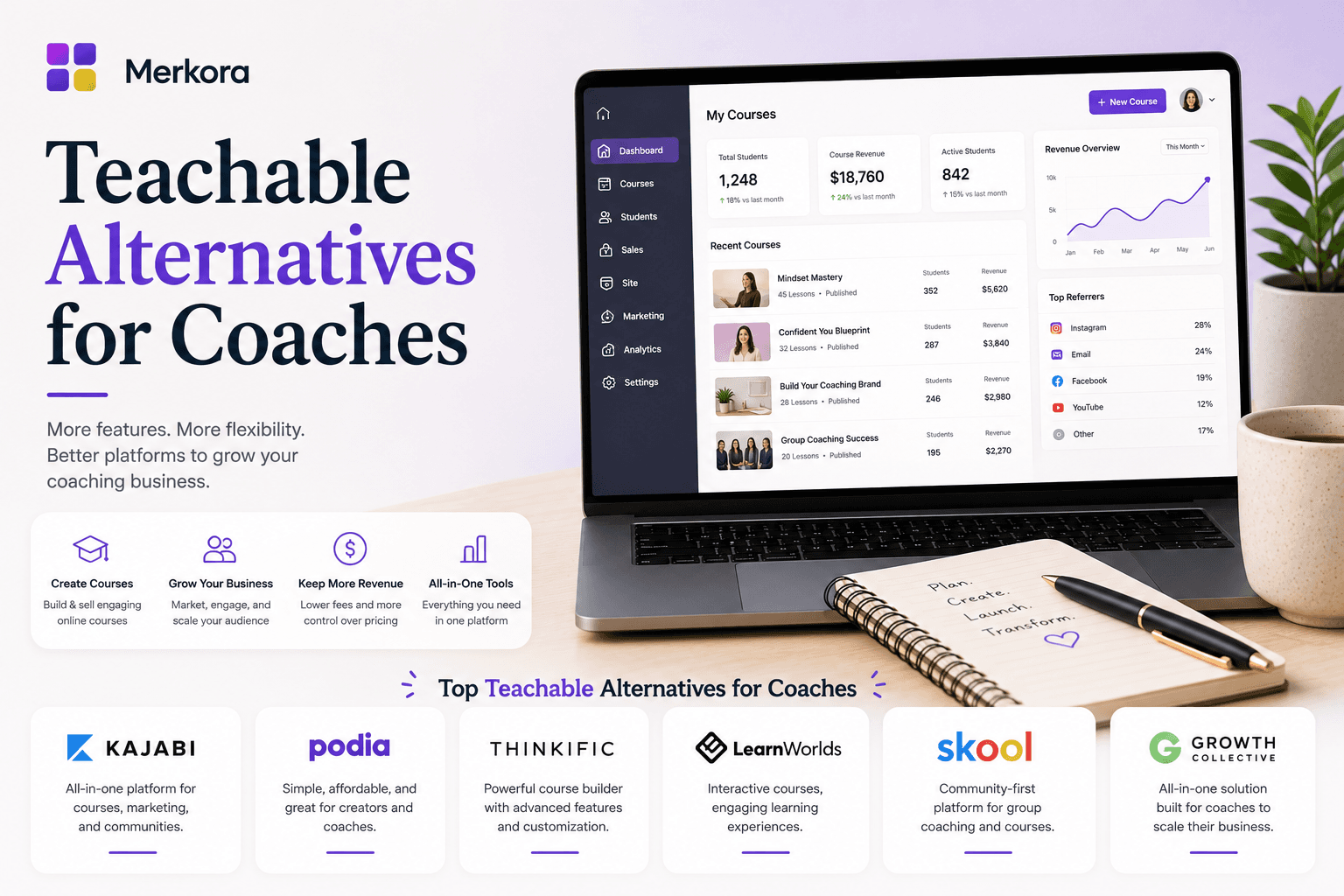
Key Takeaways
- Teachable is a good course platform. The reason coaches leave is almost always the same: they want sessions alongside courses and Teachable can't do that.
- Thinkific is the closest competitor — similar course tools, free tier, but the same session management gap.
- Kajabi covers courses + basic coaching but starts at $149/month and still lacks automatic cancellation enforcement and credit tracking.
- Merkora is the only platform in this comparison that handles structured course delivery and session management (with cancellation enforcement) in one place.
- The question to ask before switching: 'Do I primarily sell courses, or do I sell sessions with courses as a complement?' The answer determines which platform fits.
In this article
Teachable is one of the most polished course platforms available. The course builder is clean, video hosting is included, and the student experience is well-designed. For a coach whose entire business is selling self-paced courses and nothing else, it's an excellent choice.
The problem is that most coaches do more than sell courses. They run 1:1 sessions. They sell session packages. They host live group programs. They want a public page that shows everything in one place. Teachable handles none of this — and the moment you need any of it, you're adding another platform to your stack.
Here's an honest look at five alternatives, and what each one is actually better for.
Why coaches outgrow Teachable
The gap isn't Teachable's fault — it was built as a course platform, and it does that well. The gap is structural: Teachable thinks about a "student," not a "client." There's no concept of a booking, a cancellation policy, a session package, or a client history. Every course buyer is a standalone transaction, not a person with a continuing relationship to you.
Coaches who outgrow Teachable usually describe the same moment: they built a course, launched it, and realised their 1:1 clients and their course students live on completely different platforms with no connection between them. A student who finishes a course and wants to book a 1:1 session has to navigate to a different URL, create a new account, and pay through a different system. That's unnecessary friction at exactly the moment someone is most ready to invest more with you.
If you want to understand how courses and sessions can work together, the right platform matters more than most coaches realise.
Thinkific — same capability, similar limitations
Thinkific is Teachable's closest competitor: clean course builder, no transaction fees, good student experience at $36–$149/month. If you prefer Thinkific's UX or pricing to Teachable, it's a reasonable switch.
The structural gaps are nearly identical. No booking, no session management, no cancellation policy, no client records. Coaches end up with the same fragmented stack — Thinkific for courses, Calendly for booking, something else for digital products and their public presence.
Best for: Coaches whose business is entirely course-based and who prefer Thinkific's UX or its no-transaction-fee pricing model.
Podia — slightly more all-in-one, still course-first
Podia covers courses, digital downloads, memberships, and a basic coaching product at $33–$89/month. More accessible than Kajabi and easier to set up. For coaches who want a single platform for courses and digital products without Teachable's limitations on those fronts, it's worth considering.
The coaching product in Podia is limited — you can sell a coaching package as a purchase, but there's no booking management, no cancellation enforcement, no session package tracking. It's better understood as a digital products platform with a basic coaching add-on. Session-based practices quickly hit its limits.
Best for: Coaches whose primary business is digital products and courses, with occasional session selling as a secondary offer.
Kajabi — comprehensive but expensive
Kajabi handles courses, email marketing, a website builder, community, and checkout in one place. For a coach whose primary business is a large content catalogue — courses, email list, membership — it's a capable platform despite its $149–$399/month price tag.
The session and booking features are still an afterthought. There's no real cancellation policy enforcement, no credit system, no session package tracking. Kajabi was built for content creators monetising audiences, not for coaches managing client relationships. We've covered the full comparison in our post on Kajabi alternatives for coaches.
Best for: Coaches with large content businesses where courses and email community are the primary product. Overpriced if sessions are the core of what you do.
Gumroad — lightweight digital product selling
Gumroad is the simplest way to sell a digital product or a basic course. No monthly fee — it takes a 10% cut of sales. Setup takes minutes. For a coach who wants to sell a workbook, a guide, or a short course without any platform overhead, Gumroad is genuinely useful.
It doesn't support courses in any meaningful sense — video hosting, structured modules, and progress tracking aren't Gumroad's territory. And there's no session booking, no client management, no public practice page. It works as one piece of a larger stack, not as a standalone platform.
Best for: Coaches selling individual digital products — workbooks, PDF guides, short recorded workshops — as a supplement to their main practice on another platform.
Merkora — sessions and courses on the same page
Merkora was built for the gap that Teachable, Thinkific, and Kajabi all leave: a coach who runs 1:1 sessions and wants to sell courses alongside them without managing two separate platforms, two sets of client accounts, and two checkout flows.
On a single professional page, clients can book a 1:1 session with payment at booking, purchase a session package, enroll in a self-paced course, download a digital product, and register for a live group program — all without leaving. The session client and the course student are the same person in the same system. When a course student finishes and wants to book a 1:1, they book from the same page. When a 1:1 client wants to access a course, it's already in their account.
Courses in Merkora include video lessons, structured modules, and progress tracking. They live alongside your sessions, not as a separate product on a separate platform. If you're also running live group programs alongside self-paced courses, those live under the same roof as well — see our guide on the best platform for live coaching programs for how this works in practice.
Where it's still growing: The depth of course customisation and the breadth of integrations are still developing compared to platforms like Teachable or Kajabi that have been course-focused for years.
Best for: Coaches whose business is sessions-first, who want courses and digital products as part of the same professional page — not a separate platform students have to find on their own.
The question worth asking first
Before switching from Teachable, it's worth being clear about what you actually need. If courses are your entire business and sessions are a minor or future addition, Teachable or Thinkific remain solid choices. If sessions are your primary work and you want courses to live in the same place — so a client's full relationship with you exists in one system — the alternatives above address that specifically.
The friction of managing two platforms (one for courses, one for sessions) becomes more visible as your practice grows. Consolidating early is less disruptive than migrating after you've built a client base across two separate systems. Merkora is free to start. No credit card required.
Frequently asked questions
Why do coaches leave Teachable?
The most common reason: Teachable doesn't have session booking. Coaches who want to sell 1:1 sessions alongside courses need to add Calendly or Acuity separately — which means two platforms, two payment systems, and no unified client view.
What is the best Teachable alternative for coaches?
For pure course hosting at a lower price: Thinkific (free tier) or Podia ($33/month). For coaches who run sessions alongside courses: Merkora, which connects course delivery and session booking in one platform.
Is Thinkific better than Teachable for coaches?
They're very similar. Thinkific has a more generous free plan with no transaction fees. Teachable has stronger affiliate and marketing tools. Neither handles session booking natively — both have the same core gap for coaching practices.
Can I migrate my Teachable courses to another platform?
Yes. Export your video files and course materials from Teachable, then re-upload to your new platform. Student progress and completion data doesn't migrate automatically. Most platforms have import support or onboarding help for this.