Key Takeaways
- Single sessions create an adversarial no-show dynamic — every cancellation is a lost fee. Packages shift the relationship to a committed engagement.
- The three structures that work: fixed-number packages (e.g., 5 sessions), time-based programs (e.g., 3-month coaching), and retainer models.
- Price packages at a small discount (10–15%) to reward commitment, not to undervalue your work.
- Never present packages as 'buy more, pay less' — present them as 'a commitment to the result you want'.
- Existing clients convert to packages more easily than new ones. The transition conversation is short: 'I'm moving to a package model — here's why it's better for you.'
In this article
A coach who charges $150 per session and sees a client once a week earns $600 a month from that relationship. When the client drops off after four or five sessions — not because the work isn't helping, but because they're re-evaluating the commitment every month — that slot goes back into the discovery call queue. The coach starts over.
This is the default operating model for most coaches, and it's inefficient in both directions. Clients don't get the continuity that produces real results. Coaches spend as much time on acquisition as they do on the actual work.
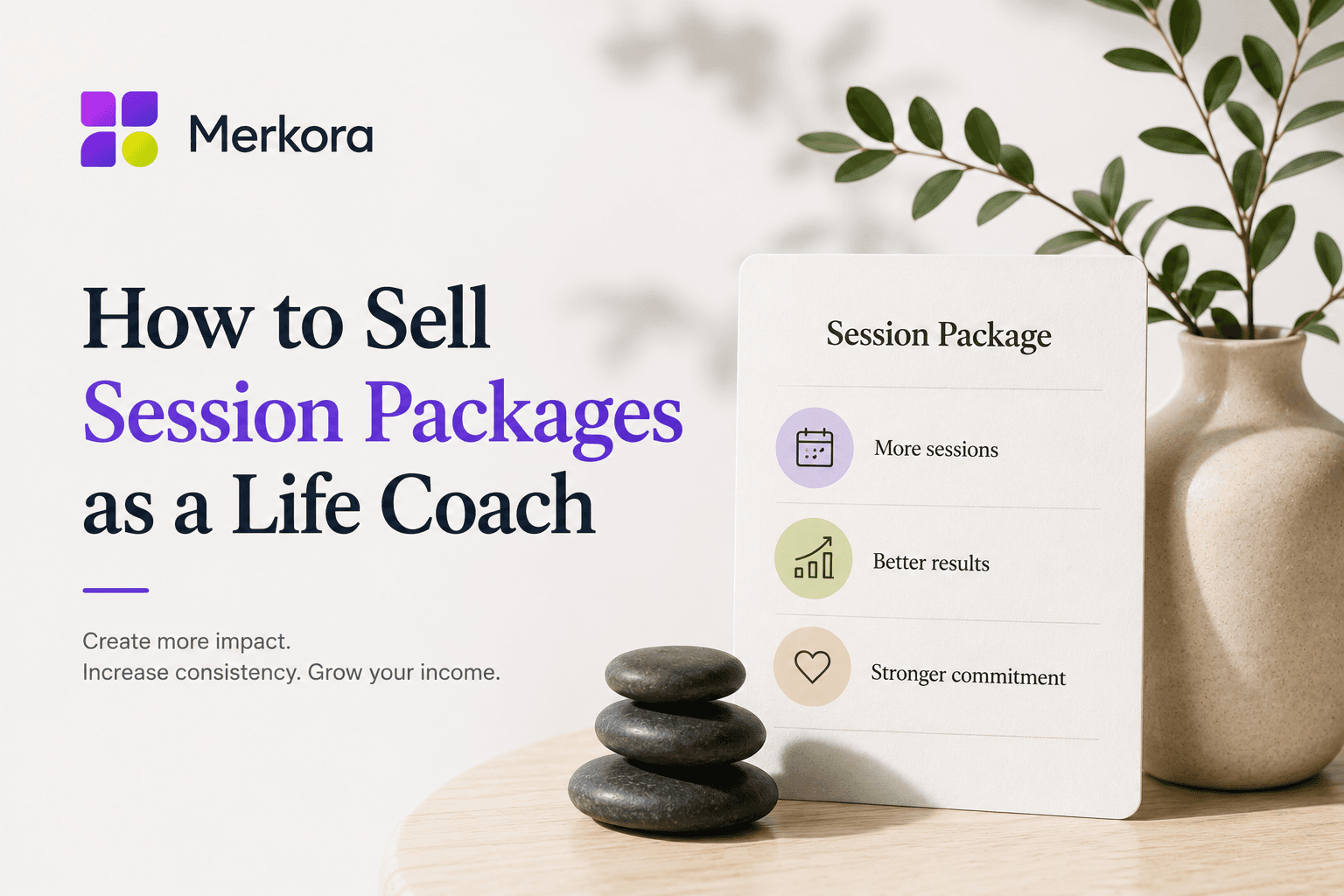
Selling session packages — multi-session commitments bought upfront — changes this structurally. The client makes one decision instead of twelve. The work can be designed as an arc rather than a series of disconnected sessions. The coach earns more from each client relationship and manages less. Here's how to build a package model that works.
Why single sessions create problems on both sides
Single sessions make sense in specific contexts: a one-off clarity call, a standalone strategy session, a first engagement before a client knows whether they want ongoing work. As the default model for ongoing coaching, they create predictable problems.
For clients: every month is a fresh buying decision. The value of the previous session feels abstract by the time they're deciding whether to rebook. A client who genuinely benefits from the work disengages not because the coaching isn't helping, but because there's no commitment anchoring them to the process. The work never builds momentum.
For coaches: the admin load of single-session management — re-onboarding clients after a two-week gap, chasing rebooks, starting over with someone new — is disproportionate to the revenue it generates. A full calendar of single-session clients can feel like full-time client management with coaching attached. The package model shifts this. The buying decision happens once. The relationship has a defined structure. The work can be designed around a real arc.
Three package structures that work
Not all coaching packages are the same. The right structure depends on the type of work you do and the clients you serve.
The focused sprint. Three to five sessions over four to six weeks, built around one specific outcome. This is the lowest-commitment entry point and the easiest first yes from a new client who isn't sure about a longer engagement. Keep the scope tight and the timeline short. "Three sessions to get your next career move clear" is a much easier commitment than "let's work together for three months." This structure is especially well suited to outcome-specific coaching — a job transition, a business decision, a specific communication challenge.
The standard engagement. Six to ten sessions over two to three months. This is the format most clients picture when they think about working with a coach. It has enough sessions to establish real momentum and produce lasting change. For most coaches, this should be the flagship offer — the default way you work, priced as your main product. Most of your revenue should come from here.
The immersive. Twelve or more sessions over four to six months, often with higher-frequency contact — weekly sessions, between-session messaging, or access to group calls. This is a high-commitment, high-investment engagement designed for clients who want the deepest level of support over a longer arc. Volume is lower, but so is acquisition cost — one client in an immersive program generates the same revenue as eight single-session clients.
Most coaches do well starting with one: the standard engagement. Get the pricing right, get the framing clear, build the delivery. Add the sprint and the immersive when there's demand for them.
How to price a session package
The most common pricing mistake: multiply the single-session rate by the number of sessions, subtract a modest discount, and call it a package price. This treats the package as a bundle of sessions rather than a commitment to an outcome — and it almost always results in underpricing.
A better approach: price from the outcome first. What does a client who fully engages with this package typically achieve, and what is that worth to them? If the outcome is "clarity on a career direction that's been causing real distress for two years" — a $900 package is probably too cheap. If the outcome is "slightly better morning routines" — it may be overpriced. The question is what the result is worth to the person who needs it, not what it cost you to deliver.
A rough framework for life coaching:
- Sprint (3–5 sessions): $400–$900. A specific problem, a defined timeframe. Priced for access — low enough to be a comfortable first commitment.
- Standard engagement (6–10 sessions): $1,200–$3,500. The core offer. Price toward the higher end if the transformation is significant or if you include support between sessions.
- Immersive (12+ sessions): $3,500–$10,000+. Deep support over a long arc. The live component — frequent contact, between-session messaging — is what justifies the price difference from the standard engagement.
If you include non-session support — messaging access, resource libraries, accountability check-ins — price it into the package. These aren't free additions. They have real value and they take real time.
How to present packages without the hard sell
Coaches who worry about seeming pushy when offering packages usually present them as an upgrade or a savings opportunity — after the single-session option is already on the table. That framing makes the package feel like a premium tier for clients who "want more." The result: most clients default to the single session.
The cleaner approach: lead with packages. Present the package as the standard way you work, and the single session as the exception.
"I typically work with clients in focused engagements of six to ten sessions. Most people find that's the time needed to make real progress on [the problem you specialise in]. I also offer single sessions for people who want to start with something more contained, or who already know they want one targeted conversation."
This positions the package as the norm. Clients who want ongoing support self-select in. Clients who want a lower-commitment entry know there's an option for them too. On your booking page, show packages first — not as an upsell below the single session, but as the primary offer. The layout itself shifts the default.
Selling packages to existing clients
Your current and past clients are the easiest people to sell packages to. They already know you, trust you, and have seen results from working with you. A client who has had two or three single sessions and found them valuable is a natural package buyer — they just haven't been offered one directly.
The most natural moment to offer a package is after the second or third session, when you both have a clearer sense of what the work involves. "Based on what we've worked on, I think a focused six-session engagement would let us get to [specific outcome] properly. I can put together a package for that — would it be useful to look at?" It's a question, not a pitch. And it's a genuine question because you actually believe the answer.
For coaches introducing packages for the first time: a direct email to your client list works well. Keep it simple. "I'm moving to a package model and offering [X sessions] for [Y price] to clients I'm already working with — here's what's included." No long explanation, no pressure. Clients who see the value will respond; clients who don't need a package right now won't, and that's a fine outcome.
What to do when a client can't finish a package
Life happens. A client who committed to a ten-session package might need to stop after six sessions — a financial change, a family situation, or because the issue that brought them to coaching has resolved. How you handle incomplete packages is both a business decision and a signal about how you work.
The cleanest model: remaining sessions convert to a credit in the client's account, valid for twelve months. The client doesn't lose the value they paid for, and you don't issue a cash refund. If the client returns, the credit is waiting. If they don't, the credit expires and the income has been earned. Having this written into the package terms — shared at the point of purchase — removes any awkwardness when it comes up. The policy is just how your practice works.
Cash refunds, by contrast, create a perverse incentive: if clients know they can get their money back mid-package, the commitment is softer than it looks. The credit model keeps the value inside your practice, keeps the client relationship open, and makes the conversation significantly easier. We cover this and other strategies in more detail in our post on how to avoid no-shows as a coach or therapist.
Where packages should live on your booking page
A package that requires clients to email you to enquire about it will sell far less than one they can read about and buy directly. The buying experience matters almost as much as the offer itself.
Your practice page should show your packages clearly — session count, what's included, price — with a direct purchase option. The client should be able to understand the offer and buy it without a discovery call, a PDF, or a redirect to a payment link on another platform.
When packages, single sessions, courses, and digital products all live on the same page, clients see your full practice at once. Someone unsure about committing to a package can see the single session or the course at a lower entry point — and then see the package as the natural next step. The layout does the upselling without any pitch. This is one of the core arguments for running your coaching business from one unified link rather than managing separate tools for booking, packages, and courses.
Coaching software built for private practice handles packages, credits, cancellation policy, courses, and your professional page in one place — without integrations to maintain or separate platforms to manage. Merkora was built for coaches who want their packages and their 1:1 bookings on the same page, so a potential client can see everything you offer and buy without being redirected somewhere else.
Frequently asked questions
How should I price a coaching session package?
A 10–15% discount off your single-session rate is the sweet spot. Enough to reward commitment, not enough to undervalue your work. If a single session is $200, a 5-session package at $900 ($180/session) is a reasonable structure.
How do I track how many sessions a client has remaining?
Most booking tools require manual tracking in a spreadsheet. A platform with a built-in credit system — where each booking automatically deducts one credit — removes this entirely. You and the client can always see the remaining balance.
What happens when a client buys a package but can't complete it?
Set a clear expiry (90–120 days is standard) and include this in the package terms at purchase. If a client genuinely can't complete it, you have the option to extend or convert unused sessions to credit — but the expiry prevents packages from becoming open-ended commitments.
Do session packages reduce no-shows?
Yes, significantly. Clients who've paid for a block of sessions in advance have stronger financial commitment to attending. The sunk cost effect works in your favour — they've already invested in the outcome.