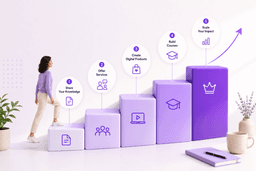

Key Takeaways
- Knowledge monetization means earning income from what you know — not just from your time spent in sessions.
- The four main income streams for practitioners are: session packages, online courses, live group programs, and digital products.
- You don't need a large audience. You need the right offer, priced correctly, sold to people who already trust you.
- The most common mistake is building a course before selling it — validate with a live version first.
- The right platform handles booking, courses, payments, and client history together — not four separate tools.
In this article
Most coaches and therapists are already monetizing their knowledge — they just don't think of it that way. Every session you run is a knowledge delivery. You're not selling time; you're selling a structured change built on years of expertise.
But if sessions are the only way you earn, your income has a ceiling. You can only see so many clients per week. When you're full, you can't grow. When you're sick, you can't earn. That's the core constraint knowledge monetization is designed to break.
What does knowledge monetization actually mean?
Knowledge monetization means building income streams from what you know — beyond charging by the hour or the session. It doesn't mean becoming an influencer or building a massive course library. It means identifying which parts of your expertise are most repeatable, most needed, and most worth someone paying for — and creating a way to deliver them that doesn't require you to be present for every transaction.
For most practitioners, knowledge monetization starts with one simple question: "What do I explain in every first session?" Whatever that is — the framework you use, the concepts you introduce, the foundational principles your clients need — that's usually the core of a product someone would pay to access independently.
Session packages — the easiest first step
Before courses or digital products, the fastest form of knowledge monetization for practitioners is selling session packages — blocks of sessions sold upfront, typically at a small discount for the commitment.
Packages change the client relationship from transactional to relational. A client who has bought a 6-session package is already committed to the process. They're less likely to cancel. They're more likely to show up prepared. And you're more likely to see the outcomes you both want.
Practically: packages reduce the overhead of rebooking after every session, reduce no-shows (because the money is already paid), and stabilize your monthly revenue. A coach selling 5-session packages at $600 can project income a month ahead. A coach selling single sessions cannot.
The tool constraint: most booking systems don't have native package tracking. You either manage it manually in a spreadsheet or add a third-party tool. The right system deducts credits automatically as sessions are booked — so you always know where each client stands without chasing spreadsheets.
Online courses — the repeatable asset
An online course is the canonical knowledge monetization product: you record it once, and it sells and delivers indefinitely without your involvement. For practitioners, the most natural course format is a structured program that teaches something clients currently learn across multiple sessions.
The mistake most practitioners make is building the course before selling it. They spend 60 hours recording modules, then launch to silence. The better approach: run it live first. Announce a 4-week program, fill it with 8–12 clients who pay to participate, and deliver it as live sessions. Record as you go. After the live run, you have course content built from real client questions and real outcomes — and you already know the demand exists.
For pricing: course prices for practitioners typically sit between $97 and $997, depending on the depth and outcome. A foundational "intro" course sits at the lower end. A comprehensive program that creates a major transformation can justify the higher end.
Live group programs — leverage your time
Group programs are the most powerful income lever available to practitioners: you deliver your expertise to 8–15 people simultaneously, each paying a fraction of your 1:1 rate but generating more total revenue per hour than any individual session.
A therapist who charges $150 per individual session, running a 6-person group program at $75 per person per session, earns $450 per hour instead of $150 — while creating group dynamics that are often therapeutically beneficial for certain client needs.
The operational challenge of group programs is logistics: enrollment, scheduling, payments, and delivery all need to work together. Clients need to pay before joining. Sessions need a live video component. Managing this across four different platforms is what causes most practitioners to abandon group programs after one attempt.
Digital products — passive income that compounds
Digital products are the most scalable form of knowledge monetization: workbooks, guides, templates, frameworks, and checklists that clients purchase and use independently. They typically sell for $15–$97 and require no delivery from you after creation.
The value isn't in the revenue per product — it's in the volume and compounding. A therapist who sells a $29 anxiety management workbook to 10 clients per month earns $290 without a session. Over a year, that's $3,480 in passive income from one product. With three products, it becomes a meaningful contribution to monthly revenue.
Digital products also serve as a lower-barrier entry point for clients who can't yet afford 1:1 sessions. Someone who buys your $29 workbook and gets results from it is a high-probability candidate for your $150 session or $600 package — they already trust the quality of your thinking.
How do you decide where to start?
The answer depends on what you already have. If you have a full client roster, start with packages — convert existing clients from single sessions to blocks, and watch your monthly revenue stabilize. If you have a waiting list, start with a group program — charge them all at once, deliver something valuable, and build the content as you go.
If you're earlier and building toward a full practice, a digital product is the fastest thing to create and put in front of people. Write what you know. Package it clearly. Price it accessibly. Let it build trust before someone commits to a session.
In all cases, the constraint isn't your knowledge. It's your infrastructure. If your booking system, course platform, and product delivery all live in different tools that don't share client data, you'll spend more time on administration than on what you're actually good at. See how knowledge monetization software for coaches handles this in one place.
Frequently asked questions
What is knowledge monetization?
Knowledge monetization is turning what you know — your skills, frameworks, methodologies, and experience — into income beyond hourly sessions. It includes selling courses, digital products, group programs, and session packages. For practitioners, it's the shift from trading time for money to building income that scales.
Do I need a large audience to monetize my knowledge?
No. Most successful knowledge monetizers start with the clients they already have. A therapist with 40 active clients can launch a course to those 40 people and generate meaningful revenue before ever running a marketing campaign. Start with the audience you have, then grow.
Should I build a course before or after I sell it?
Sell it first — or at least validate it first. Run it live as a group program or workshop, refine it based on participant questions and feedback, then record it. This approach ensures there's actual demand before you invest 60+ hours building something.
What's the best platform for knowledge monetization?
It depends on what you're selling. For practitioners who run sessions AND want courses and products, the challenge is that most platforms only do one thing. Merkora is built to handle all of it — session booking, packages, courses, live programs, and digital products — so clients access everything from one place.
How do I price my knowledge products?
Price based on the outcome, not the content. A course that helps someone build a more sustainable practice is worth more than the hours it took you to record. A useful rule: charge 10% of the transformation value as a floor. Most practitioners underprice by anchoring to content cost rather than client value.