
Key Takeaways
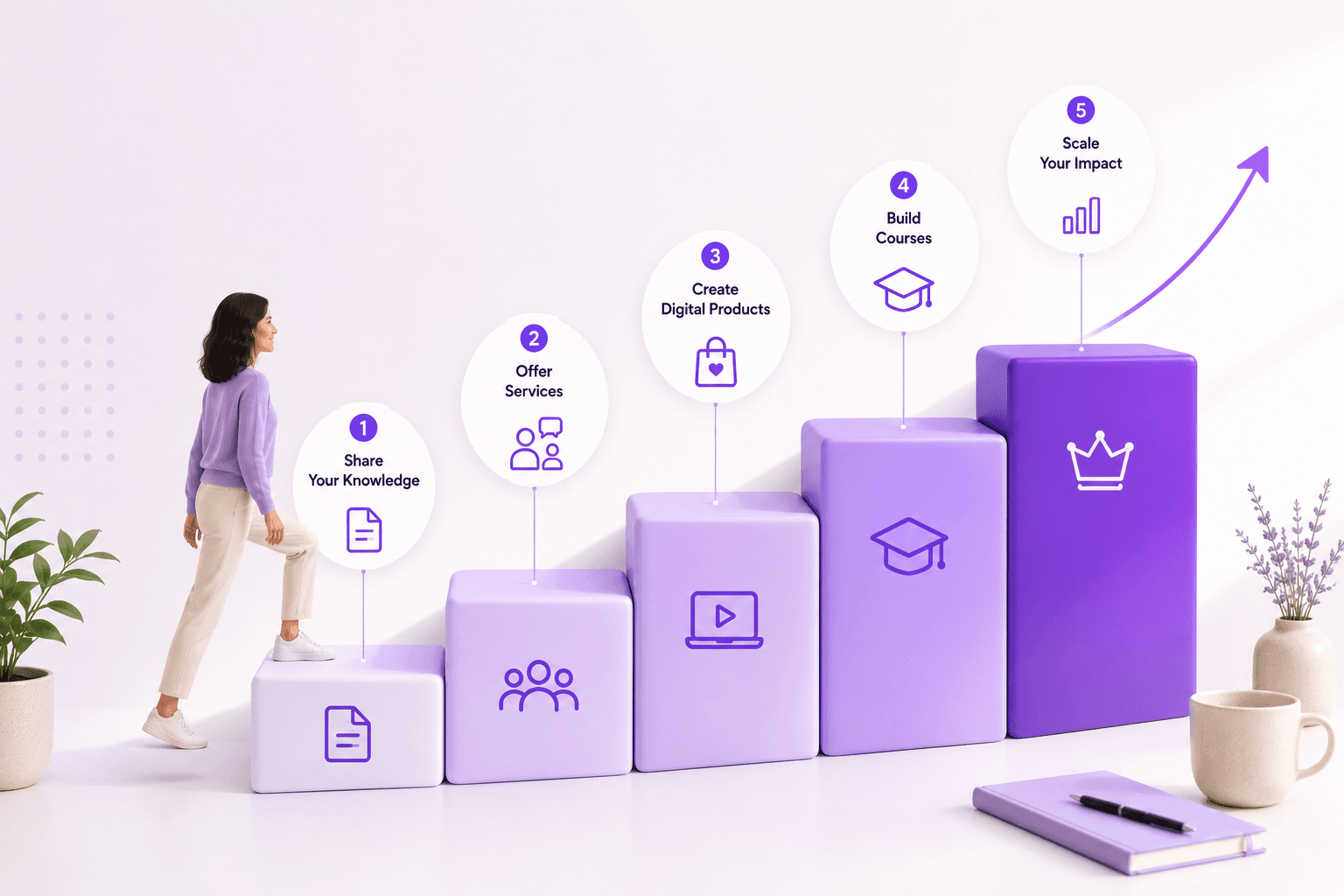
- The knowledge monetization ladder has four rungs: hourly sessions, session packages, scalable programs, and passive products.
- Most practitioners stay on rung one for their entire career — not because they can't move up, but because the path isn't clear.
- Each rung up the ladder increases revenue per client without proportionally increasing time.
- The ladder isn't about abandoning 1:1 sessions — it's about adding income streams above them.
- You can climb the ladder one rung at a time. The infrastructure has to come before the income.
In this article
When you became a coach or therapist, you didn't go through years of training to become an expert in subscription tiers and content delivery. You became an expert in the thing you help people with. The monetization side was supposed to be simple: sessions, payment, repeat.
It works — for a while. Then you hit the ceiling. Your schedule is full. You can't add more clients. You can't raise rates indefinitely. And the only way to earn more seems to be working more. That's rung one of the knowledge monetization ladder. There are three more rungs above it.
What is the knowledge monetization ladder?
The knowledge monetization ladder is a framework for understanding how practitioners can earn income from their expertise at different levels of scale and leverage. Each rung represents a different income model — more scalable, but requiring different infrastructure to deliver.
The key insight is that each rung builds on the one below it — you can't skip ahead without the foundation. Practitioners who try to launch a course before they have a reliable client base almost always struggle. Those who build up the ladder one rung at a time create something stable and compounding.
Rung 1 — hourly sessions (the starting point)
Nearly every practitioner starts here: one client, one session, one payment. You trade an hour of your expertise for a fee. This is direct, high-value, and the foundation of everything that follows.
The limitation is hard and mathematical. If you charge $150/session and see 20 clients per week, your gross income ceiling is $3,000/week — and that's before overhead, admin, no-shows, and the fact that 20 sessions per week is exhausting. You cannot grow beyond this rung without either raising your rate (which hits a market ceiling eventually) or adding a new rung.
Rung one is not a failure mode. It's the foundation. Many excellent practices never move past it — and that's fine. But if you want income that scales beyond your physical capacity, you need rung two.
Rung 2 — session packages (committed income)
Rung two is the same expertise delivered in the same format — but sold differently. Instead of individual sessions, clients buy a block upfront: 4 sessions, 6 sessions, 10 sessions. They pay once, and the credit is drawn down as sessions are used.
Packages don't increase your hourly rate, but they fundamentally change your income stability. A practice with 80% of clients on packages has a highly predictable monthly revenue. A practice with 80% of clients buying single sessions doesn't know what next month looks like.
Packages also reduce no-shows. Clients who have already paid are significantly less likely to cancel last-minute or disappear. The money committed them to the process. This matters especially for therapists and coaches whose work requires continuity — a client who ghosts after session two hasn't done the work.
The infrastructure requirement: a booking system with credit tracking. When a client books a session, one credit is deducted from their package. You need to see remaining credits clearly. Manual tracking in a spreadsheet works until it doesn't — after 10–15 package clients, it becomes an error-prone maintenance job.
Rung 3 — scalable programs (leverage your expertise)
Rung three is where leverage begins. Scalable programs deliver your expertise to multiple clients simultaneously — in formats like group coaching programs, multi-week workshop series, cohort-based courses, or live webinar series.
The math changes dramatically. A therapist who charges $150/hour for individual sessions, running a 4-week group program with 8 participants at $200 each, earns $1,600 from four sessions of group work — $400/session instead of $150. Total hours are similar; total revenue is higher; and group dynamics often enhance the therapeutic process.
Scalable programs are also the best path to rung four. When you run a group program live, you learn exactly what questions come up, what concepts need more explanation, and what exercises create the most change. That knowledge is the foundation of a course that works — built from real delivery, not theoretical planning.
The infrastructure requirement: live event scheduling, group enrollment and payment, and the ability to record and share sessions with participants. This is where most practitioners hit their first significant tool constraint — because neither standard booking systems nor standard course platforms handle group programs well on their own.
Rung 4 — passive products (income without presence)
Rung four is where practitioners build income that doesn't require them to be present at all. Recorded courses, digital workbooks, guides, templates, assessments — products that a client purchases and uses independently.
The economics of passive products are fundamentally different from every rung below. A session earns $150 once. A course priced at $297 earns $297 each time someone buys it — whether that's one person per month or a hundred. The marginal cost of delivering it to the hundredth buyer is zero.
Passive products compound over time in a way sessions cannot. A course you build this year can still be generating revenue in three years. A workbook you create in an afternoon can be selling in perpetuity. The effort is front-loaded; the income is continuous.
Rung four is also the lowest barrier to entry for new clients. Someone who can't afford a $150 session might buy a $49 workbook. If that workbook delivers genuine value, they're a high-probability conversion to rung one — they've already trusted you once. This is why digital products at the bottom of your product ladder often generate 1:1 clients as a side effect.
How do you move up the ladder without overwhelming yourself?
The answer is sequence: move one rung at a time, only after the rung below is stable.
Don't build a course until you have a reliable client base at rung one and at least some clients on packages at rung two. The packages tell you there's committed demand. The client relationships give you the social proof that makes a course credible to new buyers.
Don't run a group program until you know what topics your clients keep asking about — because those are the topics a group program can address. The answer to "what should my group program be about?" is almost always sitting in your session notes from the last year.
The practitioners who build sustainable knowledge businesses do it step by step over 12–18 months — not in a burst of ambition that burns out by month three.
The infrastructure that supports all four rungs — sessions, packages, group programs, courses, and digital products — should live in one place if possible. Splitting these across four tools means four logins, four payment systems, and four places your clients might get lost. See how knowledge monetization software for coaches handles all four rungs in one platform.
Frequently asked questions
What is the knowledge monetization ladder?
The knowledge monetization ladder is a framework for understanding how practitioners can build income beyond hourly sessions. It has four rungs: one-to-one sessions (time-limited, highest-touch), session packages (committed blocks), scalable programs (group formats and courses), and passive products (digital goods that sell independently). Each rung adds income without proportionally adding hours.
Do I have to go through all the rungs in order?
The order matters more than the pace. Packages come before courses because packages stabilize your existing income and build client commitment — which is the foundation you need to fill a group program. Courses come after live programs because live programs validate the content. Digital products convert best when buyers already know your quality.
Can I stay on rung one and still have a good practice?
Yes. Many practitioners build sustainable, rewarding practices on 1:1 sessions alone. The ladder is only relevant if you want income that scales beyond your session capacity — whether to earn more, work fewer hours, or reach people who can't afford 1:1 rates. Not every practitioner wants or needs to climb it.
What's the most common mistake when moving up the ladder?
Trying to jump to rung three or four without stabilizing rungs one and two. A practitioner who launches a course before they have a reliable session practice and committed clients is building on sand. Get packages running first — they signal the client commitment that tells you there's demand for deeper products.
What platform supports all four rungs of the ladder?
You need a platform that handles session booking (rung 1), package management with credit tracking (rung 2), live event and group program infrastructure (rung 3), and course and digital product hosting (rung 4). Most platforms support one or two rungs — which means practitioners end up patching together 3–4 tools. Merkora is built to support all four from one place.