Key Takeaways
- The private-pay versus insurance decision determines your entire software stack. Make it first — everything downstream follows from it.
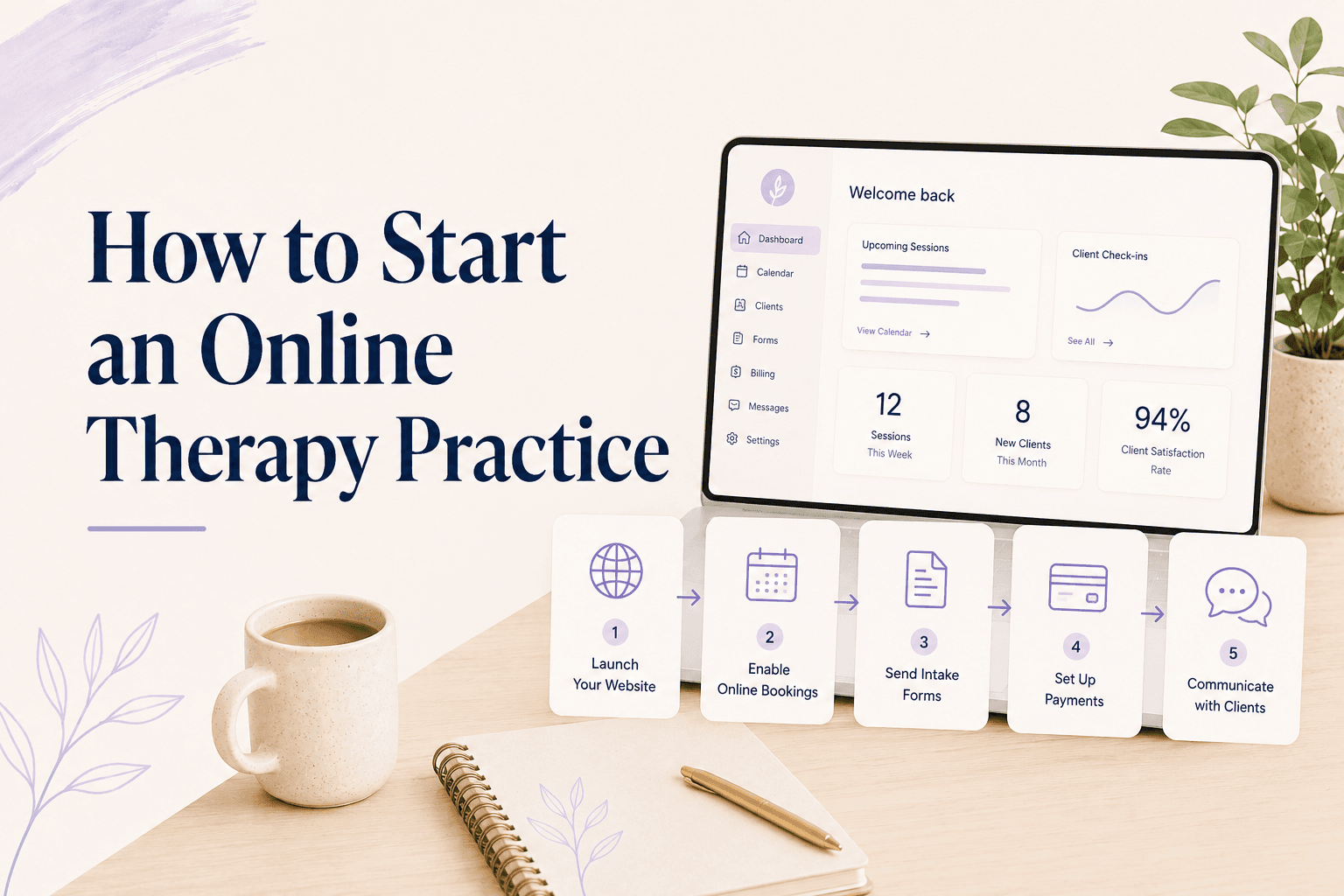
- A private-pay online practice needs five things: video with a BAA, booking, payments, intake, and a page people can find. That's it.
- Write the cancellation policy before your first client, not after your first late cancellation. Retrofitting a policy onto an existing relationship is far harder.
- Directories fill early caseloads faster than a website does, but they own the client relationship — treat them as a channel, not a foundation.
- Skip the course, the group program, and the newsletter for the first year. They're good businesses later and a distraction while you're filling a caseload.
In this article
The clinical training took years. The practice setup takes about a week — and most of that week is spent making four or five decisions that everything else hangs off. Get those right and the software question answers itself.
This is the operational side: what to decide, in what order, and what to leave until the caseload justifies it.
Settle the legal groundwork first
Three items, and none of them are software.
Licensure follows the client's location, not yours. Online practice makes it easy to accept someone in another state or country without noticing that you aren't licensed to treat them there. Check your jurisdiction's telehealth rules — in the US that may include PSYPACT or a Counseling Compact — and decide, in writing, where you can practise. Then make the intake form ask.
The other two: professional liability insurance that explicitly covers telehealth, and a business structure with a separate bank account. The account matters more than the structure at first; commingled finances are the thing that becomes painful at tax time.
Private-pay or insurance?
This decision sets your entire stack, so make it before you buy anything.
Insurance means credentialling with panels, claims, clinical documentation to the standard a payer expects, and an EHR that handles all three. It brings referrals and volume; it also brings a lower effective rate and administrative work that doesn't stop.
Private-pay means a simpler practice and a smaller pool of people who can afford it. Fewer tools, higher rate, no claims — and a slower start, because you're building demand rather than receiving it. Many therapists start private-pay with a sliding-scale allocation and revisit panels once the caseload proves out.
Three decisions about money
Make these before the first client books, because each is far harder to introduce later.
- Your rate. Set it against local private-pay rates for your credential, not against what feels comfortable. Raising it later with existing clients is possible; starting low and staying there is more common.
- When payment happens. At booking, at the session, or invoiced after. Payment at booking prevents most of the problems the other two create.
- Your cancellation policy. A window (24 or 48 hours), a fee, and a mechanism that applies it.
The third one is where new practices lose money quietly. A policy you enforce by hand is a policy you enforce inconsistently, because charging a client you'll see next week is uncomfortable — setting a no-show policy for a therapy practice covers how to write one that a system can apply on your behalf.
Pro tip
The stack you actually need
Five things for a private-pay online practice:
| Need | Requirement |
|---|---|
| Video sessions | Platform that signs a BAA |
| Booking | Availability, timezones, automatic reminders |
| Payments | Card at booking, plus fee handling |
| Intake | Forms completed before session one |
| A findable page | Who you help, your rate, a booking button |
If you keep clinical notes, add an EHR — and keep the notes there rather than in whichever tool is most convenient. Private-pay therapists who don't document clinically can skip that entire category and its price tag, which is the main financial advantage of the private-pay model. What a private practice actually needs goes tool by tool.
How will clients actually find you?
Three channels, in the order they typically produce a caseload:
- Colleague referrals. Slowest to start, best clients, highest retention. Tell every therapist you trained with what you're taking on.
- Directories. Psychology Today and its equivalents fill early caseloads faster than anything else, at a monthly cost and with the profile owning the discovery.
- Your own page. Compounds slowly, and it's the only one you keep.
Directory profiles are a channel, not a foundation. The gap most new practices leave is between the profile and the first appointment: someone reads your listing at eleven at night, emails, and waits two days for a reply. That gap between discovery and booking is where most enquiries die — a directory link that leads to a bookable consultation closes it.
What to set up before your first client
- Intake forms that must be completed before session one, including a location question
- An automatic confirmation with date, time, timezone, and a reschedule link
- Reminders at 24 and 2 hours
- The cancellation policy, visible at booking and enforced by the system
- A payment method that charges at booking
- One test run — book yourself, pay, receive every email, join the video call
The test run is the step people skip and the one that catches the broken confirmation link, the wrong timezone, and the reminder that never sends.
What to skip in year one
A course, a group program, a newsletter, a podcast, a logo you paid for, and a website with more than four pages. All of those are good businesses eventually and all of them are a way of avoiding the harder work of filling a caseload.
The one thing worth choosing early is a setup that won't need replacing when you do add a group program or a course. Moving a practice between platforms in year two is a weekend of work and a batch of confused clients — picking something that already covers courses and multi-week programs avoids the migration entirely.
Therapist software that handles booking, payments, intake, cancellation enforcement, and a public page in one place covers everything on the year-one list without five subscriptions. Merkora is free to start, which matters when the caseload is still being built.
Frequently asked questions
What do I need to start an online therapy practice?
Licensure valid where your clients are located, professional liability insurance, a business structure, and a working system for scheduling, payments, and intake. The clinical qualification is the hard part; the operational setup is a week of decisions and an afternoon of configuration.
Do I need to take insurance when starting a private practice?
No, and many online practices start private-pay deliberately. Insurance brings volume and administrative weight — credentialling, claims, clinical documentation, and an EHR to hold it. Private-pay means simpler tools and a higher effective rate, at the cost of a smaller pool of clients.
What software do I need for an online therapy practice?
Video with a signed BAA, a booking system with reminders, a payment method, intake forms, and a public page. If you keep clinical notes, add an EHR. Anything else is optional in year one.
How long does it take to fill a private practice caseload?
Most therapists take six to eighteen months to reach a full private-pay caseload, and referrals from colleagues typically outperform every other channel. Plan the finances around that timeline rather than a faster one.