Key Takeaways
- The largest loss in a private practice isn't no-shows — it's enquiries that never convert into a first booking.
- Reaching out to a therapist is an emotionally expensive act, and the willingness to do it decays within days.
- "Email me and we'll find a time" adds two waiting periods to a decision someone has already found hard to make.
- Self-service booking doesn't make the relationship less human — it removes the part of the process the client experiences as rejection.
- Track enquiries and first bookings for one month. Anything below a 50% conversion is a process problem, not a demand problem.
In this article
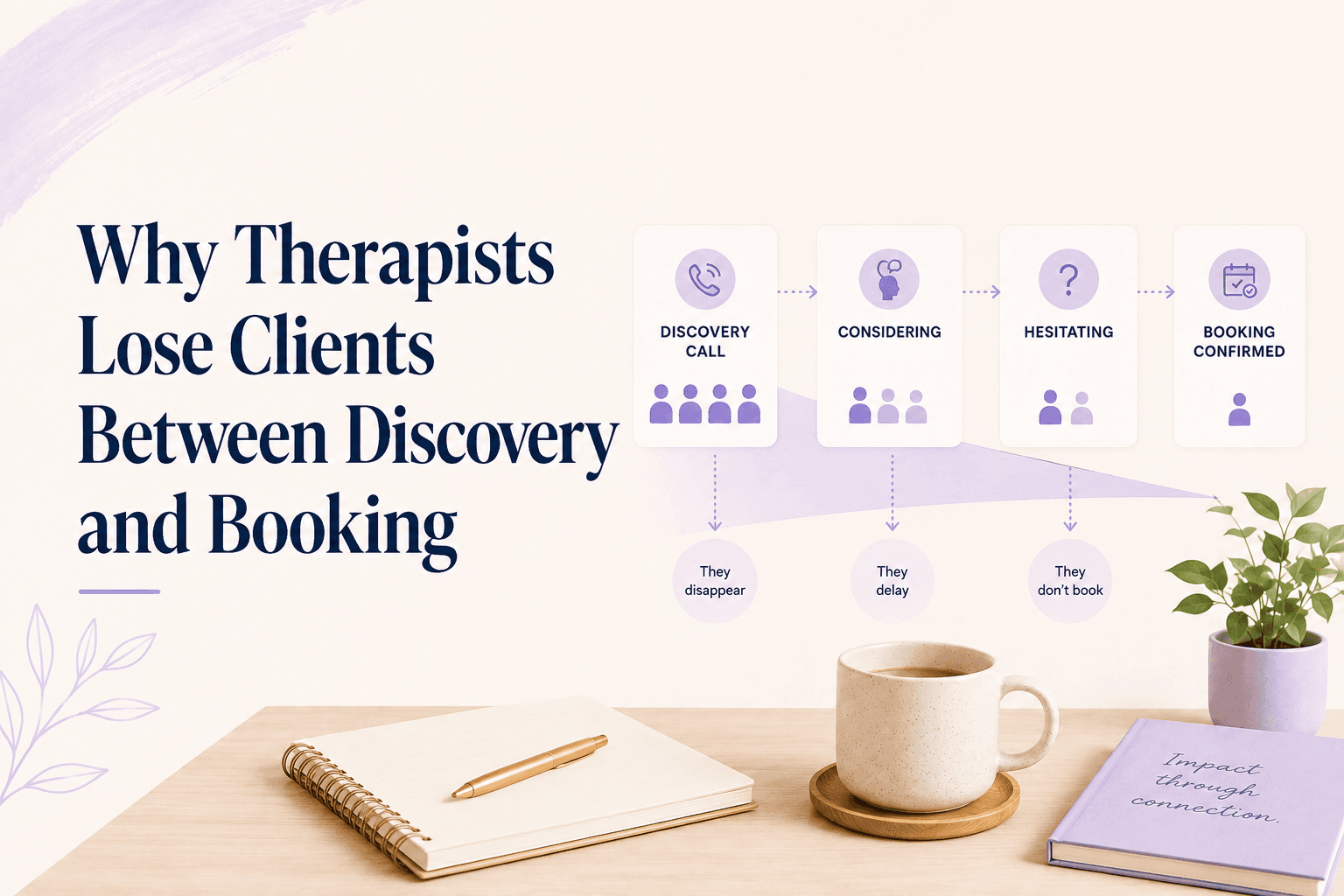
A therapist gets eight enquiries in a month and takes on three new clients. The five who didn't book weren't rejected and didn't say no — they simply never came back after the first exchange. That's the largest single loss in most private practices, and it's almost invisible because nothing ever appears on the calendar to be missed.
No-shows get all the attention because they leave a visible hole in the week. The enquiries that quietly evaporate cost more.
Where exactly does the drop-off happen?
Between first contact and first booking, and usually at one of three points: waiting for a reply, being asked to reply again to arrange a time, or being handed a process (form, phone call, email thread) instead of a slot.
Every point where the client has to act again is a point where the decision can quietly be revisited. And unlike a coaching enquiry, the decision being revisited here is one that took real effort to make in the first place.
There's a fourth point that's easy to miss: the moment someone lands on your website and can't tell whether you're taking new clients. A practice page that lists your approach and qualifications but says nothing about availability leaves the reader to guess — and the safe guess is that you're full.
Why does the gap between contact and booking matter so much?
Because contacting a therapist is not a normal purchase decision. Someone has usually been thinking about it for weeks or months, has overcome some reluctance, and has chosen a specific moment — often late at night — to finally do something about it.
That window closes. Not because they changed their mind about needing help, but because the courage was situational. By the time a reply arrives on Tuesday morning, the person who wrote at 11pm on Sunday is back in their week, and the whole thing feels less urgent and more embarrassing.
Key takeaway
What does the waiting period feel like from the client's side?
This is the part worth being honest about, because it's not neutral. From the outside, a two-day response time is normal professional practice. From the inside of someone who just disclosed something difficult to a stranger, silence has meaning.
Common interpretations, none of them accurate and all of them plausible to the person waiting:
- They're too busy to take me
- I wasn't a good enough fit to be worth replying to
- This is going to be difficult and slow
- Maybe I'm overreacting and shouldn't have written
The last one is the most damaging, and it resolves itself by not following up.
Most people also contact more than one therapist. That's sensible behaviour, and it means the practical outcome is often decided by response speed rather than fit — the person who replied first with a bookable time gets the client, not necessarily the person who was the better match.
That's an uncomfortable thing to accept, and it's also the most actionable fact in this post. You're not competing on being a better therapist at this stage. You're competing on being reachable.
Why does "email me to schedule" lose people?
Because it turns one action into a correspondence. The client writes, waits, receives some proposed times, checks their own calendar, writes back, waits again, and then has a booking. That's four actions and two waiting periods to achieve what a booking page does in ninety seconds.
It also asks the client to negotiate — to say "Tuesday doesn't work for me" to someone they've just met and want to be liked by. That's a small ask for most people and a real one for someone anxious enough to have delayed the enquiry for months.
Self-service booking removes a social interaction the client experiences as risky. The counter-argument — that it's impersonal — doesn't hold up against the alternative, which is silence of unknown length.
How to close the gap without being available 24/7
Four changes, in order of impact:
- Make a consultation directly bookable. Not a contact form — a real slot on a real calendar. You still screen during that consultation; you just capture the decision at the moment it exists.
- Send an immediate confirmation. Automatic, warm, and specific about what happens next. This replaces the silence with information.
- Put intake questions in the booking flow. You get your screening information, and the client feels the process has started rather than paused.
- Set expectations in writing. If you do need to review enquiries before booking, say when you'll reply — "I read enquiries on Monday and Thursday" converts uncertainty into a wait someone can tolerate.
The reasonable objection is clinical: some clients shouldn't be booked without screening, and a fully open calendar risks taking on someone outside your scope. That's real. The answer isn't a contact form — it's a bookable consultation with a short intake attached, which gives you the screening information before you meet and gives them a confirmed appointment tonight. If the consultation shows it isn't a fit, you refer on, which you'd have done after the email exchange anyway.
Point three does double duty: it's the same intake information you'd collect anyway, and collecting it upfront makes the first session more useful. This is the practical core of setting up online booking for a therapy practice.
What should you measure?
Two numbers, for one month:
- How many enquiries did you receive?
- How many became a first booking?
Below 50% is a process problem, not a demand problem — and it's fixable without any marketing at all. Most practitioners have never counted, which is why the leak persists for years while attention goes to getting more enquiries.
Once the first booking happens, the next leak is attendance, which is a different problem with different tools — a clear no-show policy and software that enforces it handle that end.
Therapist software that lets someone go from your page to a confirmed first consultation in one sitting closes the gap where most of this loss happens. Merkora was built so the enquiry, the intake questions, and the booking are one step — the person who found the courage at 11pm has an appointment before the feeling passes.
Frequently asked questions
What percentage of therapy enquiries turn into booked clients?
It varies widely, but practices that require an email exchange before scheduling commonly convert 30–50% of enquiries. Practices where a client can book directly from the first contact point often see substantially higher rates, because there's no waiting period for intent to decay.
Should therapists offer instant online booking or screen clients first?
Both are possible at once. Offer a bookable consultation slot rather than a request form — you still screen during that consultation, but the client's decision is captured immediately rather than left waiting for a reply.
How quickly should I respond to a therapy enquiry?
Within 24 hours if you're responding manually, and the sooner the better. But the more reliable fix is removing the need for a response entirely — an automatic confirmation and a bookable slot beat a fast personal reply you can't guarantee every week.
Does online booking feel impersonal for therapy clients?
Not in practice. Clients experience a slow or uncertain response as impersonal; a clear path to a first session reads as competence. The personal part of the relationship starts in the session, not in the scheduling exchange.