
Key Takeaways
- Paperbell is a coaching platform with light content features. Kajabi is a content platform with a light coaching feature. Neither is a compromise version of the other.
- For session booking, packages, and contracts, Paperbell wins clearly — it was designed around the coaching appointment.
- For structured video courses, memberships, and email marketing, Kajabi wins clearly, and nothing Paperbell offers is close.
- Neither charges a late-cancellation fee automatically. On both, enforcing your own policy means processing the charge yourself.
- Paperbell is $57/month flat; Kajabi runs $69–$399. If you need both halves properly, the comparison you're actually running is the wrong one.
In this article
Most coaches comparing Kajabi and Paperbell are trying to answer a question neither product is designed to answer: can one tool run both my sessions and my course? They're reading feature lists looking for overlap, and the overlap is thin.
These aren't competitors that happen to price differently. They were built for different businesses, and the fastest way to choose is to work out which business you're in.
The one-sentence difference
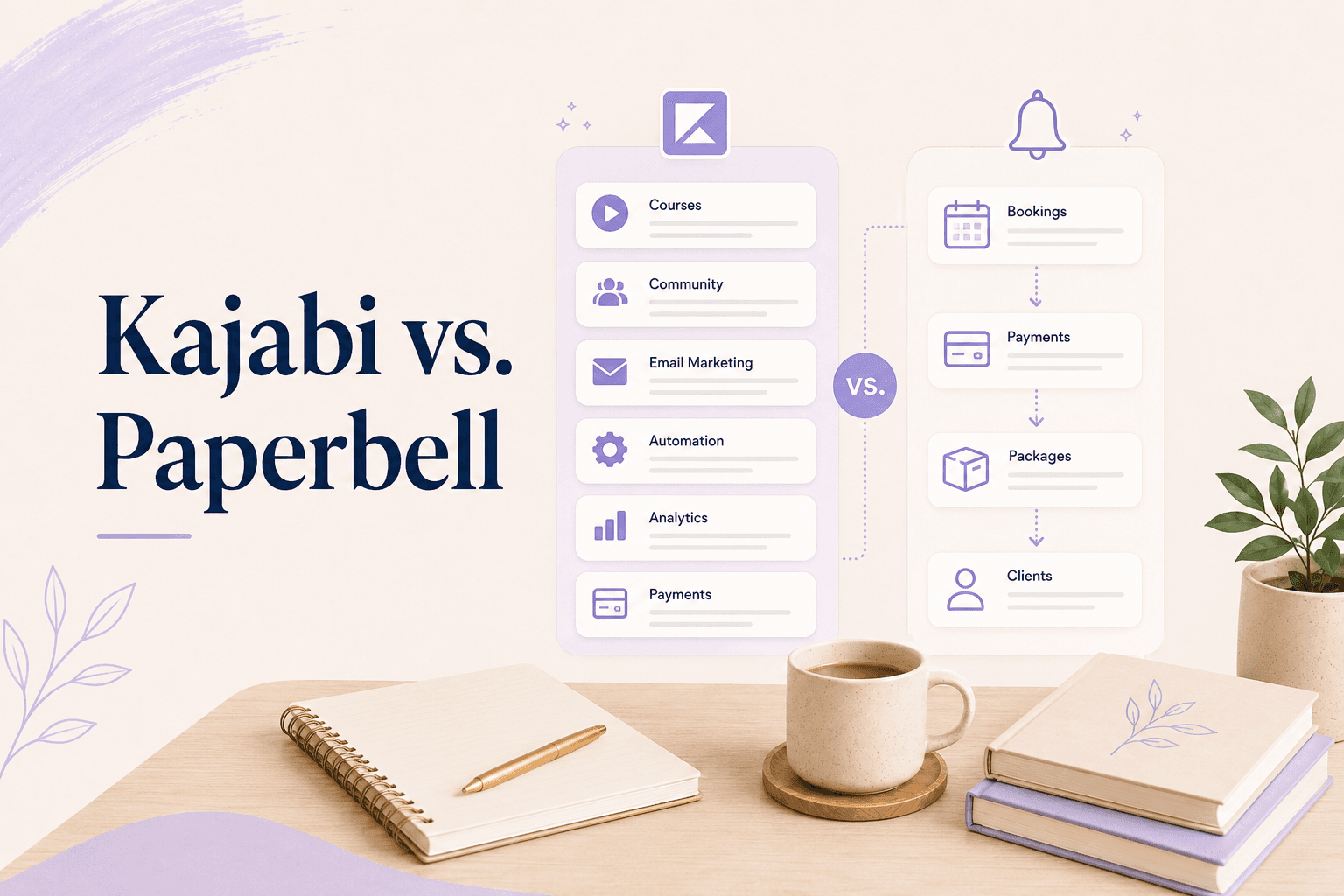
Paperbell is a coaching platform with light content features; Kajabi is a content platform with a light coaching feature.
Everything else in this comparison follows from that sentence. Paperbell starts from the appointment — availability, packages, contracts, the client. Kajabi starts from the product — the course, the offer, the landing page, the list. Each is strong where it started and thin where it didn't.
Booking and scheduling: Paperbell, clearly
Paperbell handles the coaching appointment properly. Availability rules, timezone handling, packages that clients book against, intake forms and contracts attached to the booking, and a clean client-facing flow that doesn't feel like a generic scheduler.
Kajabi's Coaching product does something narrower: it sells access to sessions. There's no real availability management, no package drawdown, and no contract step, so coaches running sessions on Kajabi almost always add Calendly or Acuity — at which point the all-in-one argument for Kajabi has already collapsed. Our comparison of coaching software and Calendly covers why a generic scheduler is a weak floor for a practice.
Courses and content: Kajabi, clearly
Kajabi's course builder is genuinely good — modules, video hosting, drip scheduling, completion tracking, memberships, and a community layer, plus the email and landing page tools around it. If your plan is a self-paced flagship course sold to an audience, this is what that job looks like when it's done well.
Paperbell doesn't compete here and doesn't claim to. You can attach resources and files to an offer, which covers worksheets and a welcome pack. It does not cover a structured six-module video course with progress tracking, and trying to force one in produces something your buyers will notice.
Packages, payments, and no-shows
Both take payments cleanly, and both use Stripe underneath, so the checkout experience is comparable. Paperbell adds package handling — a client buys six sessions and books against the balance — which Kajabi has no equivalent for.
On late cancellations, the two are more alike than either would like. Paperbell lets you publish a cancellation policy; charging the fee when someone cancels two hours out is still a manual action. Kajabi doesn't attempt policy enforcement at all.
Neither platform will charge a no-show fee without you doing something about it — which in practice means the fee goes uncharged, because nobody enjoys invoicing a client they'll see next week. Automating no-show fees explains why automatic enforcement is the only version that survives contact with a real client relationship.
Price, honestly compared
| Paperbell | Kajabi | |
|---|---|---|
| Entry price | $57/mo ($47 annual) | $69/mo (Kickstarter) |
| Realistic working tier | $57/mo — one plan | $149/mo (Basic) |
| Transaction fees | None | None |
| Session booking | Full | Minimal |
| Course builder | None | Full |
| Email marketing | Basic | Full |
Prices as of 2026 — check each provider for current rates.
Paperbell's single flat plan is a real advantage: no tier anxiety, no feature gates, no recalculating at renewal. Kajabi's tiers mean the plan you sign up on and the plan you end up on are frequently not the same one.
What neither of them does
Three gaps show up on both sides of this comparison:
- Automatic cancellation enforcement. Policy text on both, automatic charging on neither.
- One record across sessions and content. On Paperbell your course lives elsewhere; on Kajabi your sessions do. Either way a client exists twice.
- Live group programs with real scheduling. Paperbell schedules groups but doesn't host them; Kajabi hosts content but doesn't schedule sessions.
Key takeaway
How to choose
- Sessions are your business, content is a bonus → Paperbell. It'll do the job for years and the price never surprises you.
- Courses are your business, sessions are occasional → Kajabi, or one of the cheaper Kajabi alternatives if you don't use the marketing machinery.
- Both matter and you're tired of maintaining two systems → the comparison you're running is between two half-answers.
That third case is the common one, and it's why coaches end up paying for Paperbell and a course platform, or Kajabi and a scheduler, and reconciling clients between them by hand. The alternative is coaching software where bookings, packages, cancellation enforcement, courses, and live programs sit on one client record — see the all-in-one platform comparison for how the options in that category differ. Merkora covers both halves and starts free.
Frequently asked questions
What's the difference between Paperbell and Kajabi?
Paperbell is built around coaching appointments — booking, packages, contracts, and client records. Kajabi is built around selling content to an audience — courses, memberships, landing pages, and email automation. They overlap on payments and little else.
Is Paperbell cheaper than Kajabi?
Yes, substantially. Paperbell is a flat $57/month ($47 billed annually) with no transaction fees. Kajabi runs from $69/month for Kickstarter to $399/month for Pro. Prices as of 2026 — check both sites for current rates.
Can Kajabi replace Paperbell for booking coaching sessions?
Not comfortably. Kajabi's Coaching product sells session access but lacks a proper availability calendar, package credit tracking, and contract handling. Coaches who try it usually end up running a separate scheduling tool alongside.
Can Paperbell replace Kajabi for selling a course?
Only for simple material. Paperbell attaches files and resources to your offers but has no structured course builder with modules, video hosting, and progress tracking. For a real self-paced course you'd need something else.
Which is better for a coach who does both sessions and courses?
Neither on its own, which is why coaches in that position often run both and pay twice. A platform that treats sessions and courses as one business — one client record, one checkout, one page — removes the split rather than managing it.