Key Takeaways
- Most coaches with a conversion problem don't have an audience problem — they have a gap between interest and payment.
- Content is the only lever that's visible, measurable, and always available, which is why it absorbs effort that belongs elsewhere.
- The average path from "I want to work with you" to a paid booking involves three to five manual steps, each one a place to lose someone.
- A system, in a solo practice, means anything that produces the right outcome without you remembering to act.
- Count the steps between a decision and a payment. Under three is healthy. Over four is where the revenue goes.
In this article
A coach posts four times a week for eight months, builds an audience of a few thousand people, gets steady comments and DMs, and signs three clients. The obvious conclusion is that the content needs to be better. It's almost never the right one.
Look at what happens after somebody says "this is exactly what I need." They send a DM. You reply the next morning. They ask about pricing. You reply again. You send a Calendly link. They book. You send an invoice. Somewhere in that chain, most of them stop.
Why does more content feel like the answer?
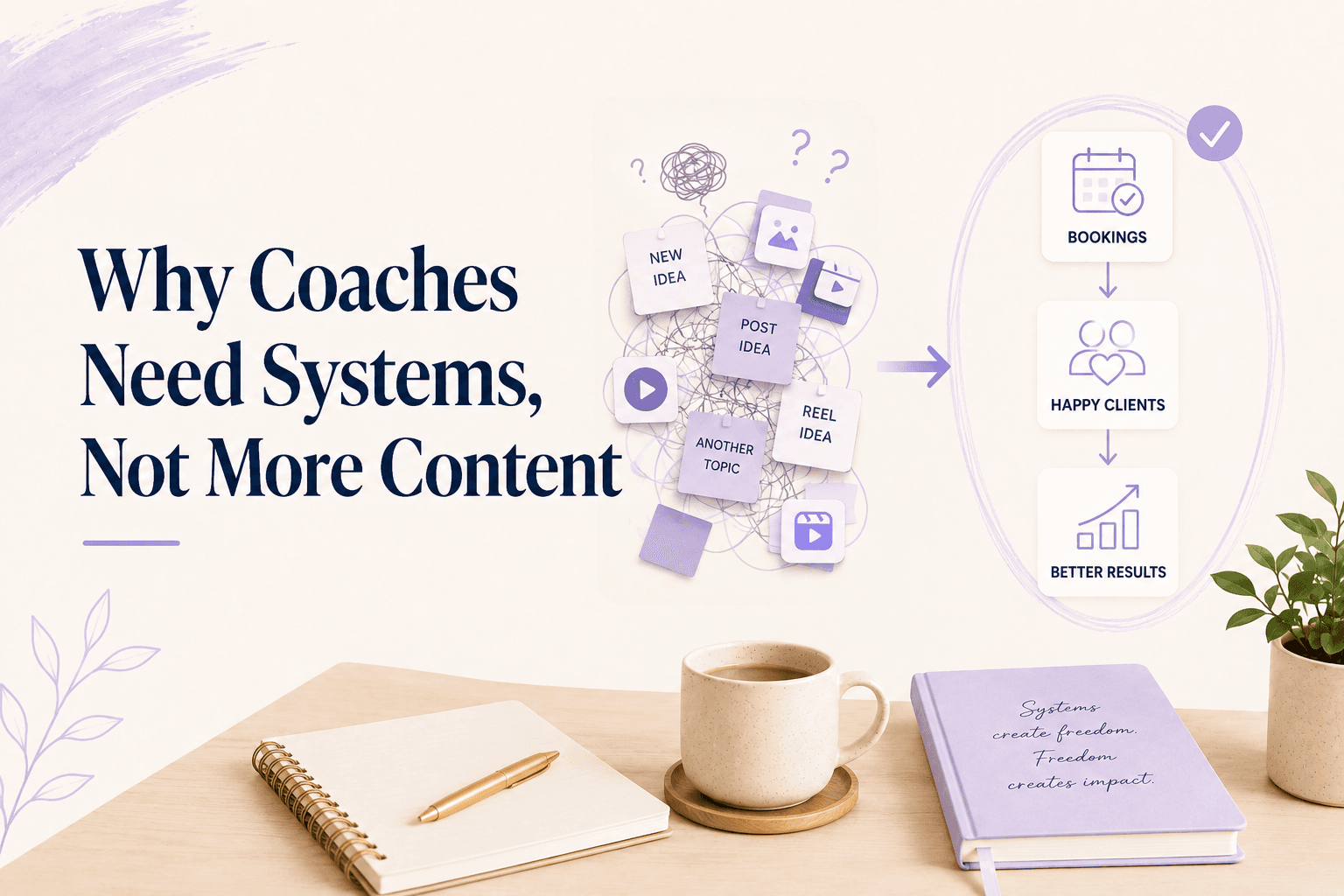
Because it's the only part of the business that's visible, measurable, and always available. You can always write another post. You can see the likes. It feels like progress within the hour.
Operations have none of those properties, which is why they lose every time they compete with content for attention. Nobody feels a rush from fixing the four-step gap between a DM and a payment — but that's the fix that changes the revenue number.
The advice environment reinforces it. Almost every coaching-business resource is about visibility — audience, niche, hooks, consistency — because that's what sells courses about coaching businesses. Very little of it is about what happens in the four days after someone says yes.
There's also a comfort factor worth naming. Writing a post is safe. Asking for money and building the machinery that asks for money on your behalf is not. Content can quietly become the thing you do instead of selling.
What actually happens after someone decides to work with you?
Map it for your own practice. For most coaches it looks something like:
- They see the offer and want it
- They message you, because there's no other way to proceed
- They wait — an hour, a day, a weekend
- You exchange messages about price and availability
- You send a scheduling link
- They book a slot
- You send an invoice or a payment link
- They pay, maybe
Eight steps, four of which require you to be awake and available. Every one of them is an exit. The decision was made at step one and then given seven opportunities to reverse itself.
Where does the leak really sit?
Almost always between decision and payment, and specifically in the waiting. Intent decays fast — the person who wanted to book at 11pm on Sunday is a different person by Tuesday afternoon when your reply arrives.
The three most common leaks, in order of how much they cost:
- DM-only booking. Every enquiry requires your personal response before it can progress.
- Payment separated from booking. The client books, then waits for an invoice, then pays — two decisions where there should be one.
- Unclear offers. If someone has to ask what things cost, you've made asking a required step.
The DM leak deserves a defence, because plenty of coaches will say conversations are where their best clients come from. That's often true. The point isn't to remove the conversation — it's that the conversation shouldn't be the only route. Someone who already knows what they want should be able to book without one, and someone who wants to talk still can.
The third leak is a content problem, in fairness — but it's a page problem, not a posting problem. It's the same reason most practitioner websites don't convert: they describe the practitioner rather than letting someone act.
What does a "system" actually mean in a solo practice?
Nothing corporate. A system here means any part of the business that produces the right outcome without you remembering to act. That's the whole definition.
Key takeaway
Concretely, for a coaching practice, that's four things: a page that states the offers and prices, a booking flow that shows real availability, payment collected at the point of booking, and a cancellation policy that applies itself. None of these require automation software. They require the booking and the payment to be the same action.
The common objection is that this makes the business impersonal. It does the opposite in practice. Every hour you're not spending on scheduling messages and payment follow-ups is an hour available for the part of the work that actually needs you. The automated parts are the parts nobody wanted a human for.
How to find your own leak in one afternoon
Go through your own client path as a stranger would, and count:
- Open your Instagram bio on a phone. How many taps to see a price?
- From there, how many taps to book a specific time?
- From there, how many taps to pay?
- How many of those steps require you to respond personally?
Any answer above three taps to a paid booking, or any step requiring your personal response, is where your conversion is going. This test takes fifteen minutes and is more useful than a month of content strategy. It's the same diagnostic behind running a coaching business from one link — the goal is fewer stops between wanting and paying.
What changes when the system runs itself?
Three things, and only the first is about money. Bookings arrive while you're in sessions or asleep. You stop being the bottleneck for your own business. And the content you're already making starts converting at a rate that makes it worth continuing.
That last point is the one worth sitting with. The content wasn't the problem — it was pouring into a container with a hole in it. Fixing the container makes every past post retroactively more valuable, which is a better return than any new post.
Coaching software that collapses those eight steps into three is the whole intervention — the offers, the booking, and the payment behind one link. Merkora was built so a person who decides at 11pm on Sunday can be a paying client by 11:02, without you being awake for it.
Frequently asked questions
Why am I posting consistently but not getting coaching clients?
Usually because the path from interest to payment is too long. If someone has to DM you, wait for a reply, get a link, and then book, most of them drop out somewhere in that chain — regardless of how good the content was.
How many steps should there be between interest and booking?
Two or three. See the offer, choose a time, pay. Every additional step — an email exchange, a separate invoice, an account creation on another site — costs a measurable share of people who had already decided.
What counts as a "system" for a solo coach?
Anything that produces the right outcome without you remembering to act: a booking page that shows real availability, a payment taken at booking, a reminder sequence, an automatic cancellation fee. Not software for its own sake — just work that doesn't depend on your attention.
Should I stop making content?
No. Content creates the interest; systems convert it. The problem is only that content is the easier of the two to keep doing, so it tends to expand to fill the time the other work should occupy.