Key Takeaways
- Most coaching menus grow one objection at a time — each new package is a fix for a specific 'no' from a specific person.
- Every additional offer moves work onto the buyer. Someone who can't tell which option is theirs usually picks none.
- Each live offer costs you a price decision, a description, a delivery format, and a place in every conversation. Seven offers is seven sets of that.
- Three offers cover almost every practice: a way in, a core commitment, and something that continues afterwards.
- You don't delete offers to simplify. You stop presenting them, keep them bookable by link, and let existing clients finish what they bought.
In this article
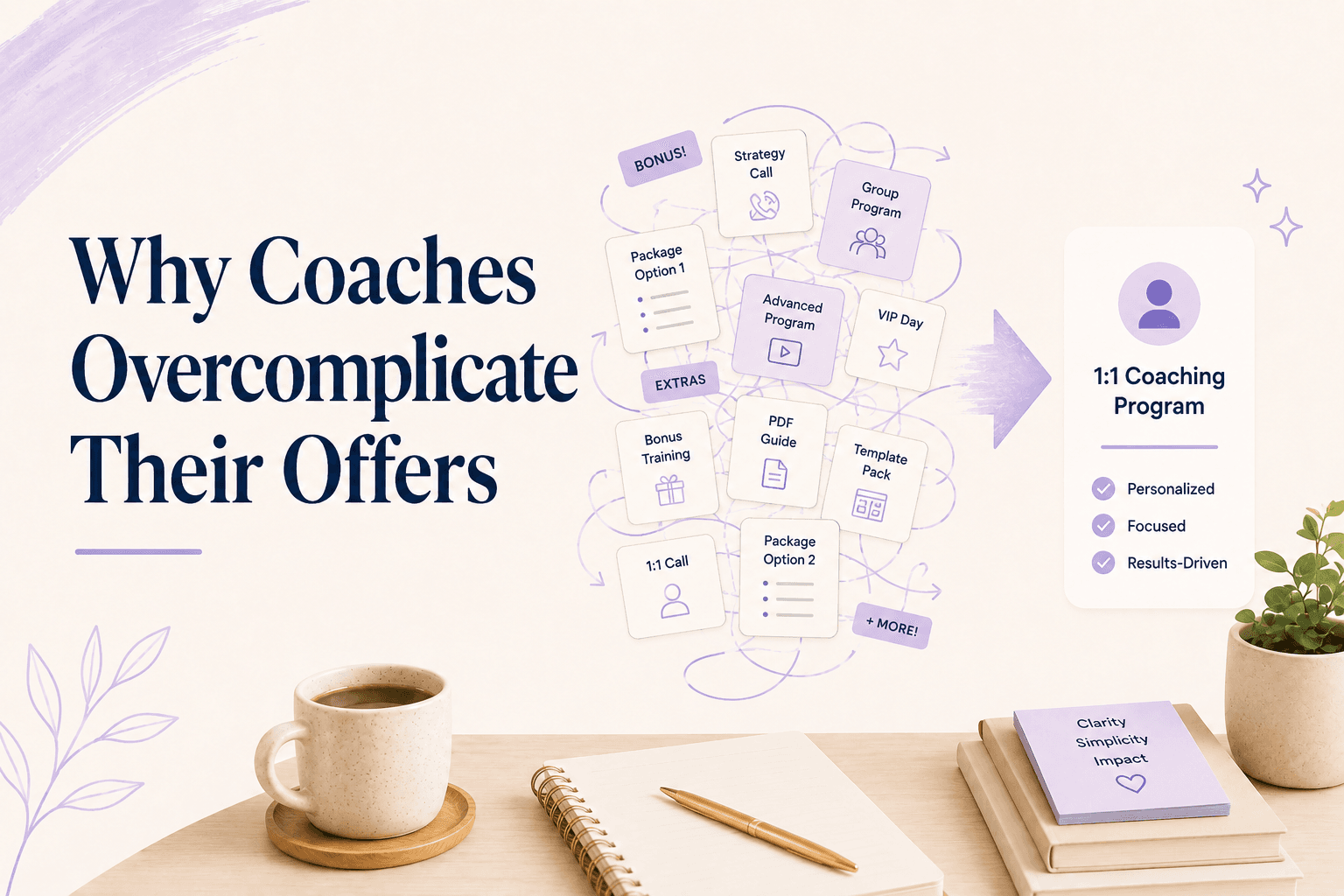
Open a coaching website and count the ways to work with someone. A free discovery call, a single session, a three-session package, a six-session package, a VIP day, a group programme, a self-paced course, sometimes a membership. Eight routes to the same person.
None of that was planned. Every one of those offers was created for a good reason, in response to a real conversation — which is precisely why the menu is so hard to prune.
What the menu actually looks like
Do the audit: list every offer you'd sell if someone asked tomorrow, and next to each, write how many people bought it in the last six months.
The usual result is that two offers carry the business and the rest have sold once or twice each. Not zero — that would be easy. One or two, which is exactly enough to justify keeping them and not nearly enough to justify what they cost.
Why does the menu grow?
Because every "no" has a shape, and each shape suggests a product.
Someone said six sessions felt like too much of a commitment, so you built a three-session package. Someone couldn't afford the package, so you added single sessions. Someone wanted the material without the calls, so you recorded a course. Someone wanted more access than the package allowed, so there's a VIP tier now.
Every one of those decisions was reasonable in isolation. Together they've turned a clear offer into a comparison exercise, and the person doing the comparing knows less about coaching than you do.
What it costs the client
Work. Choosing between eight options means deciding not just whether to work with you but which version of you to buy — and the buyer has no basis for that judgement. They don't know whether they need three sessions or six. That's what they were hoping you'd tell them.
A long menu quietly transfers your expertise back to the buyer, at the exact moment they're least equipped to use it. The common outcome isn't the cheaper option — it's "let me think about it," which is where most of these decisions go to die.
The pattern is the same one behind free discovery calls that don't convert: an extra step that feels generous and functions as a delay.
What it costs you
Each live offer carries a fixed overhead that has nothing to do with how often it sells:
- A price you have to justify against the others
- A description someone has to read
- A delivery format you have to keep good at
- A place in every sales conversation you have
- A row in whatever system tracks who bought what
Six offers means six of everything, maintained by one person between sessions. The VIP day that sold twice last year is still costing you a paragraph on your page and thirty seconds of every enquiry call.
The three-offer structure
Almost every solo practice fits into three:
- A way in. One paid first session, priced so the decision is small. Paid, not free — it filters and it starts the relationship as a professional one.
- The core. The package that represents how you actually work. Six sessions, eight weeks, whatever the real unit of change is in your practice.
- Something that continues. A course, a group, or ongoing monthly sessions for people who finished the core and want to keep going.
Three offers with an obvious order beats eight offers with no order, because the buyer's question changes from "which of these?" to "yes or not yet?" — how to structure session packages covers the middle one in detail.
Key takeaway
Simplifying without losing revenue
Retire, don't delete. Three steps, none of which require an announcement:
- Take the low-volume offers off your page but keep their booking links working
- Let anyone mid-programme finish exactly what they bought
- Keep one link in your back pocket for the client who genuinely needs the odd format
The fear is that revenue drops in proportion to what you removed. It doesn't, because those offers weren't producing much — and the enquiries that used to end in "let me think" start ending in a booking instead.
Nobody writes to ask where the VIP day went. People notice a shorter menu far less than the person who built it does.
The thirty-second test
Send your offers page to someone who doesn't know your work. Ask them, after half a minute, which option is for someone in their situation.
If they hesitate, the problem isn't your copy — it's the number of options. Hesitation on a page is a booking you'd have lost, observed under laboratory conditions.
The operational side matters here too: a simple offer structure only stays simple if your tools can express it. If your package needs a spreadsheet to track sessions used, or your course lives on a different platform from your bookings, the complexity comes back as admin instead of confusion. Coaching software that holds sessions, packages, courses, and group programmes on one page keeps a three-offer structure genuinely three offers — running a practice from one tool covers what that takes. Merkora was built for exactly that shape.
Frequently asked questions
How many offers should a coach have?
Three is enough for most solo practices: an entry point, a core package, and a continuation. More than that and you're asking the buyer to run a comparison they don't have the information to run.
Won't I lose clients if I remove options?
You lose the clients who would have bought a specific removed thing, and you gain the larger group who couldn't decide at all. In practice the second group is bigger, because indecision is the most common outcome of a long menu.
Should I offer single sessions as well as packages?
Only if single sessions serve a real purpose — a first meeting, or occasional check-ins for former clients. As a standing option beside a package, a single session mainly gives people a cheaper way to postpone the decision they were about to make.
How do I retire an offer I've been selling?
Stop showing it, keep the booking link alive for anyone mid-programme, and let existing clients finish what they bought. Nothing needs announcing — people notice a shorter menu far less than you expect.