Key Takeaways
- A free discovery call has no commitment cost, so it attracts browsers alongside buyers — and both take 30 minutes of your week.
- Ten free calls a month at a 20% conversion rate costs roughly a full working day for two clients.
- Charging a small fee (or requiring a deposit that's credited to the first session) typically cuts bookings and raises conversion at the same time.
- Most "free call" problems are actually qualification problems — three questions in the booking form fix more than the pricing change does.
- The highest-leverage change isn't the price of the call. It's whether the next step can be booked and paid for before the call ends.
In this article
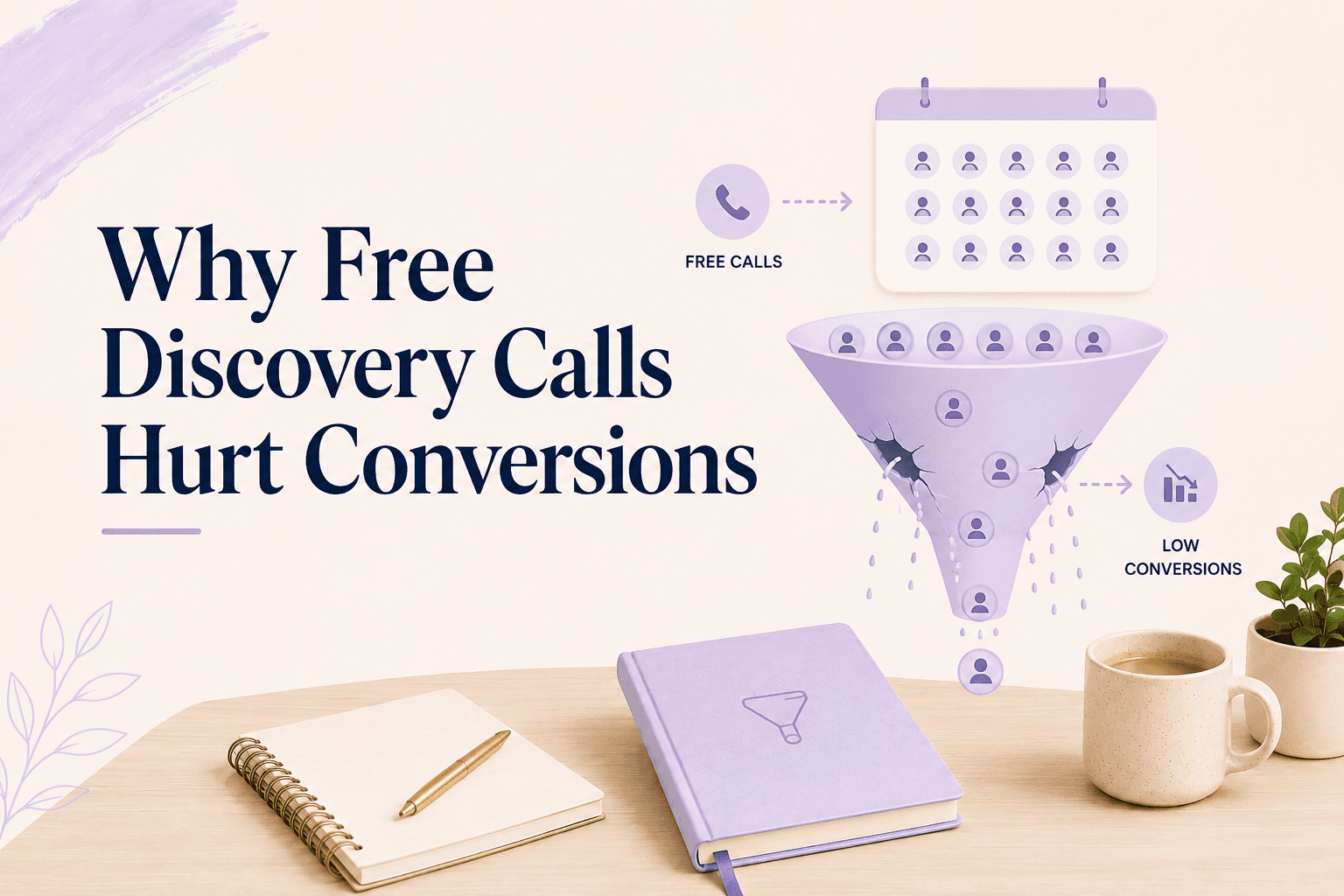
A coach with ten free discovery calls a month and a 20% conversion rate is spending roughly five hours to sign two clients. That's not a disaster. It becomes one at twenty calls a month, which is what happens when the free call starts working as a marketing asset.
The free discovery call is close to universal advice in coaching, and it's not wrong. It's just incomplete — the version most practitioners run has no filter on it, and the cost of that shows up in the calendar rather than the bank account.
What is a discovery call actually for?
It exists to answer one question for both people: is this a fit? Not to demonstrate your method, not to give a free session, not to build rapport for its own sake. A fit assessment that ends in either a booking or a clean no.
Most discovery calls underperform because they've quietly turned into free coaching sessions. The prospect leaves with a plan, feels helped, and has no remaining reason to pay. You've delivered the value and skipped the transaction.
Why does "free" attract the wrong bookings?
Because price is a filter, and removing the filter doesn't just add good prospects — it adds everyone. A free 30-minute call with an expert is worth booking even if you have no budget, no timeline, and no intention of hiring anyone.
Three patterns show up predictably on free calls:
- People researching the field who wanted a conversation with a practitioner
- People with a specific one-off question who leave satisfied and don't return
- People who would be good clients but aren't ready for months
Only the third group is worth the slot, and only if you have a way to stay in touch. The other two consume the same 30 minutes as a qualified prospect.
There's a subtler cost too. A calendar full of free calls feels like traction, which makes it harder to notice that the pipeline isn't producing revenue. Busy and productive look identical from the inside when the busy work is client-facing.
What does a free call actually cost you per month?
Count it properly. A 30-minute call is closer to 45 minutes of your time once you include the notes, the follow-up email, and the context switch on either side. At fifteen calls a month, that's over eleven hours — more than a full working day — spent on conversations that mostly don't convert.
Then add the no-show rate. Free calls no-show at dramatically higher rates than paid sessions, for the obvious reason: there is nothing at stake. Practitioners regularly report a third of free calls not showing, against under 10% for paid sessions.
Important
Does charging for the first call reduce bookings?
Yes, and that's usually the point. What changes is the composition: fewer bookings, far higher conversion, and almost no no-shows. Practitioners who move to a paid intro session commonly find their total signed clients stays flat or rises while the number of calls drops by half.
The clients who disappear when you ask for $25 were unlikely to pay $150 a session later. This is the same dynamic that makes upfront payment the strongest lever on no-shows — commitment is a filter as much as a deterrent.
The exception is genuinely worth respecting: if you're new, have no testimonials, and your pipeline is empty, free calls buy you reps and referrals. Charge once you have more demand than calendar.
Therapy sits differently again. A short free consultation is close to standard practice, and it serves a clinical purpose — fit between therapist and client is a genuine variable, not a sales concern. The fix there isn't charging; it's making the consultation directly bookable so it happens while the person is still willing.
The version that works for most coaching practices is the credited fee: charge $25–50 for the first call and apply it to the first paid session if they go ahead. Nobody who hires you pays extra, and nobody who was never going to hire you books.
What to change instead of scrapping the free call
There are four adjustments, roughly in order of how much they change per hour of work to implement:
- Add three qualifying questions to the booking form. What are you working on, what have you tried, what's your timeline. This alone removes most unqualified bookings, because people who aren't serious don't fill it in.
- Take a card at booking, even at $0. A stored payment method plus a stated no-show fee changes attendance immediately.
- Shorten the call to 20 minutes. Short calls stay diagnostic. Long calls become sessions.
- Charge a small fee credited to the first paid session. The strongest filter, and it costs the client nothing if they go ahead.
Number one is free and usually enough. Number four is the one that ends the problem permanently.
Keep the qualifying questions short and open. Three text fields, no dropdowns, no multi-page form. The goal isn't data — it's a small amount of effort that browsers won't spend and serious prospects won't notice. Anything longer starts costing you good bookings alongside bad ones.
A useful side effect: the answers make the call better. Walking in already knowing what someone has tried and what their timeline is means the twenty minutes goes to diagnosis rather than background.
How to make the call convert without a hard sell
The single highest-leverage change is structural, not conversational: the next step should be bookable and payable before the call ends. Not "I'll send you a link" — an actual booking, made while the intent is at its peak.
Every hour between the call and the payment is an hour for the decision to cool. If your process requires you to write a follow-up email, wait for a reply, send an invoice, and then send a scheduling link, you've inserted four opportunities to lose someone who had already said yes. It's the same gap that costs practitioners clients between first contact and first booking.
Selling a package rather than a single session at that moment also does real work — it converts one decision into several sessions of commitment, which is why session packages outperform pay-as-you-go for most practices.
Coaching software that lets you send one link where a prospect books, pays, and gets confirmed in the same flow removes the cooling-off window entirely. Merkora was built so the discovery call, the intake questions, the package, and the payment all sit behind one page — which is what makes charging for the first call feel normal rather than awkward.
Frequently asked questions
Should coaches charge for discovery calls?
Not always, but it's worth testing. Charging a small fee credited toward the first session filters out browsers while keeping serious prospects. If your calendar is full of calls that don't convert, the price is the fastest thing to change.
What's a good conversion rate for discovery calls?
For a well-qualified free call, 20–40% is typical. For a paid intro session, 50–70% is common because the people who pay have already decided they want to work with someone. If you're below 20%, the problem is qualification, not sales skill.
How long should a discovery call be?
Twenty minutes is enough for most practices. Sixty-minute free calls tend to deliver the coaching for free, which removes the reason to book a paid session. Keep it short enough that the value is in the plan, not the session itself.
How do I stop no-shows on free discovery calls?
Free calls have the highest no-show rates of any booking type because there's nothing at stake. Requiring a card on file, or charging a small refundable fee, drops no-shows sharply — as does a short reminder sequence with a one-click reschedule link.