
Key Takeaways
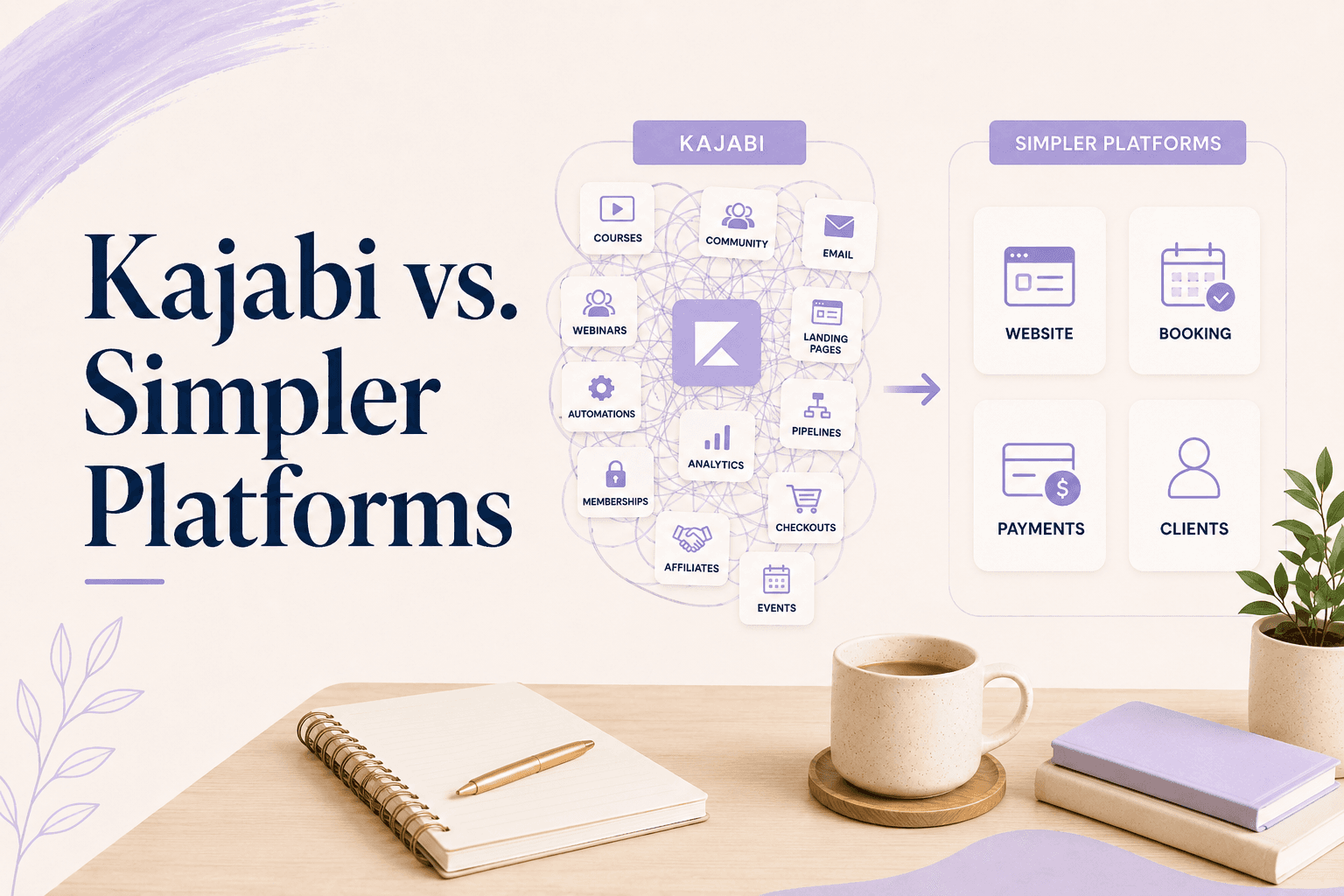
- Kajabi's price isn't the real cost — the configuration surface is. Funnels, pipelines, automations, and email sequences all need decisions before anything is live.
- Most practitioners use four of Kajabi's features and pay for fourteen. The audit takes ten minutes and usually ends the debate.
- Simpler platforms aren't cut-down versions of Kajabi — they make different assumptions about who's doing the work and how much time they have.
- You genuinely lose things by simplifying: deep email automation, affiliate programs, and multi-step funnels are real capabilities that lighter tools don't match.
- If your revenue comes from a list you email, stay on Kajabi. If it comes from clients you see, the complexity is working against you.
In this article
Here's a test worth running before your next Kajabi renewal. Open the platform and count how many of its top-level sections you opened in the last thirty days. Most practitioners get to four: products, a landing page, the checkout settings, and the contacts list.
Kajabi has roughly fourteen. That gap — not the $149 a month — is what people mean when they say a platform is too much for them.
What are you actually buying at $149 a month?
A marketing system with a course platform inside it. Kajabi's real product is the funnel machinery: pipelines, email sequences, automation triggers, landing page variants, affiliate tracking, and an audience database designed for segmentation.
The course builder is the part everyone shops for and the smallest part of what you're paying for. That's not a criticism of Kajabi — it's an accurate description of a tool built for people who sell to lists, and it explains why the price feels wrong to people who sell to clients. The full Kajabi pricing breakdown goes tier by tier if you want the numbers.
The usage audit: which features do you actually run?
Go through the list honestly. For each one, the question isn't "could this be useful?" — it's "did I use this in the last month?"
| Kajabi feature | Who it's for | Typical practitioner use |
|---|---|---|
| Course builder | Everyone | Constant |
| Checkout and offers | Everyone | Constant |
| Landing pages | Everyone | Set once |
| Email broadcasts | List owners | Occasional |
| Automation sequences | Launch marketers | Rare |
| Pipelines / funnels | Launch marketers | Rare |
| Affiliate program | Scaled course sellers | Almost never |
| Communities | Membership businesses | Sometimes |
The pattern is consistent: the features practitioners use daily are the commodity ones, available on every platform in the category. The features that justify Kajabi's price are the ones that sit untouched.
What does "simpler" actually mean?
Not fewer capabilities — different assumptions about who's operating the thing. A simpler platform assumes the operator is the same person delivering the service, working in the gaps between sessions, and it optimises for time-to-live rather than configurability.
Concretely: fewer objects to configure before anything works. On Kajabi, a course sale involves a product, an offer, a checkout, a landing page, a thank-you page, and usually an email sequence. On a simpler platform it's a product with a price on a page that already exists. Same outcome, six decisions fewer.
The second difference is defaults. Complex tools ship neutral and expect you to make every choice; simpler tools ship opinionated and expect you to override the few that don't fit. If you have a marketing background, neutral is freedom. If you're a practitioner, it's homework.
What do you give up by simplifying?
Three things, and they're real:
- Email automation depth. Conditional branching, behaviour triggers, and segmented sequences. Lighter platforms send transactional email well and campaigns barely at all — you'd pair one with a dedicated email tool.
- Funnel building. Multi-step opt-in to tripwire to upsell flows with variants. If you run launches, this is the machine, and simpler tools don't have it.
- Affiliate programs. Tracking, payouts, and partner dashboards, which matter once other people sell for you.
Anyone telling you a simpler platform matches Kajabi feature for feature at a third of the price is selling something. The honest framing is that you're choosing which capabilities you want to be excellent, and paying attention costs as much as money.
Pro tip
Who should stay on Kajabi?
People whose revenue genuinely comes from an audience. If you have a list of several thousand, run two or three launches a year, and can name the sequence that converts, Kajabi is doing work that a lighter tool would leave undone — and $149 against launch revenue is a rounding error.
The clearest signal is where your last ten sales came from. If the answer is an email sequence, stay. If it's a referral, a discovery call, or a client renewing a package, the funnel machinery isn't what's earning your money — see why systems beat more content for what usually is.
The three-question test
Ask these in order. They resolve the decision faster than any comparison table:
- Where did your last ten sales come from? Email list, or people you spoke to?
- What broke last month? A funnel that underperformed, or a client who cancelled two hours before and couldn't be charged?
- What are you not doing because setup is too fiddly? If you've been meaning to launch a second course for four months, complexity is costing you revenue, not protecting it.
Two out of three pointing at clients rather than campaigns means the platform is aimed at a business you don't run. The alternative isn't a stripped-down Kajabi — it's a tool built around sessions, packages, and clients, with courses alongside them. Selling courses and sessions together explains why that combination is the actual dividing line, and the Kajabi alternatives comparison covers the specific options.
Coaching software that assumes you're a practitioner rather than a marketer makes different trade-offs throughout — fewer screens, faster setup, and booking and cancellation handling that Kajabi doesn't attempt. Merkora is built on that assumption, and starts free.
Frequently asked questions
Is Kajabi overkill for a small coaching practice?
Usually, yes. Kajabi is built to run launches to an email list of thousands — funnels, pipelines, automation sequences, affiliate programs. A practice with 15 to 30 active clients uses almost none of that, and every unused feature is still a screen you navigate past.
What's the main difference between Kajabi and simpler platforms?
Assumed operator. Kajabi assumes someone whose full-time job is marketing to an audience. Simpler platforms assume a practitioner who does the work between sessions. That difference shows up in setup time, defaults, and how much has to be configured before anything is live.
What do I lose by moving from Kajabi to a simpler platform?
Multi-step funnel building, deep email automation with conditional branching, affiliate program management, and a large template library. If you actively use those, they're not easy to replace and the move probably isn't worth it.
How long does Kajabi take to set up?
Realistically days to weeks for a full setup — site, products, checkout, emails, automations. Lighter platforms aim for an afternoon. That gap matters most for practitioners who are building the business in the hours between clients.