Key Takeaways
- The creator economy is built on audience size and content reach — it rewards virality and volume.
- The expertise economy is built on depth of knowledge and client relationships — it rewards trust and transformation.
- A coach with 60 committed clients is in the expertise economy. An influencer with 200,000 followers is in the creator economy.
- The tools, metrics, and strategies are different — following creator economy advice as an expertise professional wastes effort.
- Coaches and therapists don't need more content or a bigger audience. They need better systems for delivering expertise and protecting income.
In this article
"Build your audience. Post consistently. Grow your reach." If you've ever looked for business advice as a coach or therapist, you've heard this — probably a hundred times. And if you've tried it and felt like it wasn't working, it's probably not because you weren't trying hard enough.
It's because that advice is for a different economy. Not yours.
What is the creator economy?
The creator economy is the ecosystem of individuals who build audiences — on YouTube, TikTok, Instagram, Substack, podcasts — and monetize those audiences. The monetization mechanisms are audience-dependent: ad revenue, brand sponsorships, affiliate deals, and product sales at volume.
In the creator economy, reach is the asset. A creator with 500,000 YouTube subscribers can earn $10,000/month from ads without a single direct client relationship. The income is passive and disconnected from individual relationships — which is both its strength and its constraint.
The creator economy has its own infrastructure: YouTube, Substack, Patreon, ConvertKit, Kajabi's creator tier. Metrics that matter: subscribers, views, open rates, monthly listeners. Success looks like going viral, landing a sponsorship, or building a list of 50,000 people.
What is the expertise economy?
The expertise economy is the ecosystem of independent professionals who earn income from applying and selling their knowledge — directly, in structured relationships, to committed clients. Coaches, therapists, consultants, tutors, and trainers are all expertise economy professionals.
In the expertise economy, trust and transformation are the asset. A therapist with 55 active clients can build a $7,000/month practice without a single viral post, a newsletter list, or a YouTube channel. The income comes from the quality of the results she delivers, the referrals those results generate, and the packages and programs she offers her existing client base.
The expertise economy has its own infrastructure: booking systems, session packages, cancellation policies, course platforms, live program tools. Metrics that matter: client retention, no-show rate, revenue per client, package uptake. Success looks like a full schedule, stable monthly revenue, and clients who come back and refer others.
What are the core differences?
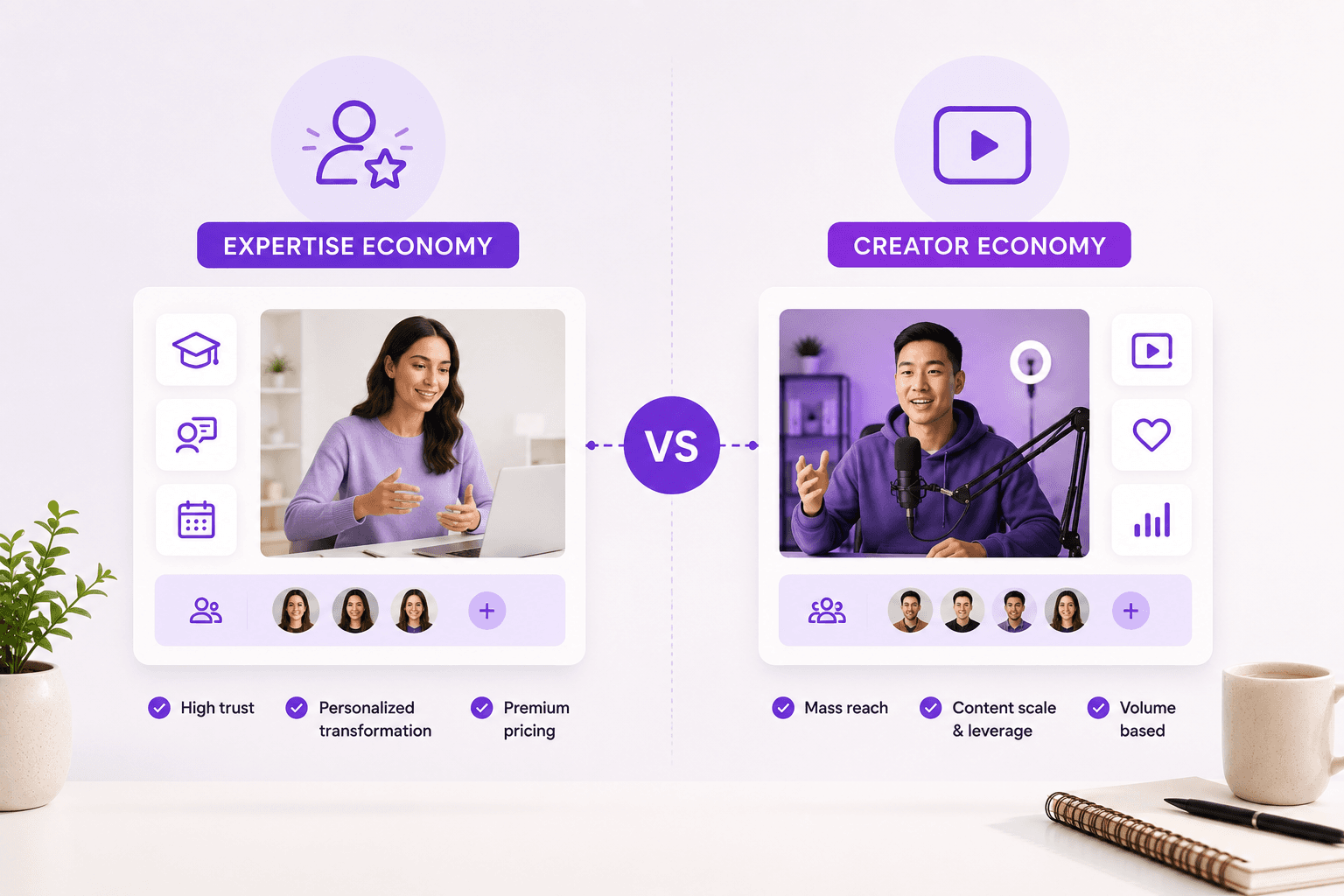
| Dimension | Creator Economy | Expertise Economy |
|---|---|---|
| Core asset | Audience size and reach | Depth of knowledge and trust |
| Primary income | Ads, sponsorships, volume sales | Sessions, packages, courses, programs |
| Relationship type | One-to-many, passive | One-to-one or one-to-few, active |
| Key metric | Followers, views, subscribers | Client retention, revenue per client |
| Scale mechanism | Grow the audience | Packages, courses, group programs |
| Barrier to entry | Low — anyone can start a channel | Medium — requires real expertise |
Why are coaches and therapists expertise economy professionals?
The answer is in what clients are actually paying for. When someone hires a life coach or books a therapy session, they're not paying for content — they're paying for structured transformation delivered through a real relationship. They want results, accountability, and expertise applied specifically to their situation.
That's the expertise economy model in its purest form: specific knowledge, delivered in relationship, generating transformation. The coach's followers on Instagram are not the business. The clients are the business. The referrals are the business. The packages and courses built on top of those relationships are the business.
Some coaches try to straddle both — building an audience and selling expertise. This is possible, but it's slower and harder than most realize. The fastest path to $5,000/month as a coach is not building a following. It's filling a client roster and adding one package or program on top of it.
Why does creator economy advice backfire for practitioners?
Creator economy advice is optimized for one goal: audience growth. Post daily. Build in public. Optimize for reach. For expertise economy professionals, this advice creates a specific problem: it takes enormous time and energy to produce content for people who are not your clients, while your actual business-building activities — client delivery, package design, referral cultivation — get less attention.
A coach who spends 10 hours per week creating content for 2,000 Instagram followers has less time for the 40 clients who are already paying her. The 40 clients are the leverage — not the 2,000 followers.
This doesn't mean social media has no value for practitioners. A clear, professional presence helps with credibility and discovery. But the metric worth optimizing is not follower count — it's client conversion rate. One referral from a satisfied client is worth more than 500 strangers who liked a post.
What infrastructure fits each model?
Creator economy professionals need a content creation platform, an email list tool, and a way to sell digital products at volume. The infrastructure is built for reach and scale.
Expertise economy professionals need session booking with scheduling and payments, a cancellation policy that actually enforces fees, session packages and credit tracking, a place to host courses and digital products, and live event infrastructure for group programs. The infrastructure is built for relationships and revenue protection.
Most practitioners end up using creator economy tools for an expertise economy business — Kajabi (built for creators) instead of a platform built for practitioners. The result is either missing functionality (no real booking, no cancellation enforcement) or paying for features they don't need (audience analytics, email sequences for subscriber lists).
The expertise economy deserves its own infrastructure. If you're a coach or therapist ready to build on a platform that fits your actual business model, see what coaching software for the expertise economy looks like.
Frequently asked questions
What is the difference between the creator economy and the expertise economy?
The creator economy is built on content and audience reach — YouTubers, TikTokers, and newsletter writers monetize through ads, sponsorships, and volume. The expertise economy is built on depth and trust — coaches, therapists, and consultants monetize through sessions, packages, courses, and programs sold to committed clients. Completely different metrics, income models, and strategies.
Are coaches and therapists part of the creator economy?
Most coaches and therapists are in the expertise economy, not the creator economy. If your income comes from client relationships — sessions, packages, programs — you're expertise economy. If your income comes from audience monetization — ads, brand deals, follower-based selling — you're creator economy. Some practitioners bridge both, but they're fundamentally different businesses.
Do I need social media followers to succeed in the expertise economy?
No. The expertise economy rewards trust and transformation, not follower counts. A therapist with 50 long-term clients and a strong referral reputation can build a full, sustainable practice without a single social media post. Followers are optional. A clear offer and a reliable booking system are not.
Can I be in both the creator economy and the expertise economy?
Yes — some practitioners build content that generates an audience and then monetize through expertise-based products. But these are different activities requiring different time and tools. Building an audience to sell your expertise is a longer path than selling your expertise directly to people who already need it.
Why does this distinction matter for my business?
It matters because the strategies are different. If you're an expertise economy professional following creator economy advice — posting daily, building an audience, chasing reach — you're optimizing the wrong metric. You don't need 10,000 followers. You need 50 committed clients and the right infrastructure to serve them well.