Key Takeaways
- The gig economy sells interchangeable labor by the task — any qualified driver or tasker can fulfill the job. The expertise economy sells a specific practitioner's knowledge, which can't be swapped for the next available provider.
- Gig platforms set the price and take a cut. Expertise professionals set their own price, based on the value of the transformation they create.
- Gig income is capped at hours available × rate. Expertise income scales through packages, programs, and products that don't require another shift.
- Many coaches and therapists unconsciously price like gig workers — single sessions, booked one at a time, no packaging — even though their business supports far more.
- The fix is pricing the outcome instead of the hour, and adding at least one income stream that doesn't require your direct presence for every delivery.
In this article
You drive for a rideshare app on Tuesday nights. You also run a coaching practice with a dozen steady clients. On paper, both are "gig work" — independent, self-employed, no employer, no benefits. In practice, they're nothing alike, and treating them the same is quietly capping what your coaching practice could be earning.
The gig economy and the expertise economy get lumped together constantly — same tax forms, same "be your own boss" marketing, same freelance platforms hosting both. But the economics underneath are completely different, and the difference changes how you should price, package, and think about your practice.
What is the gig economy?
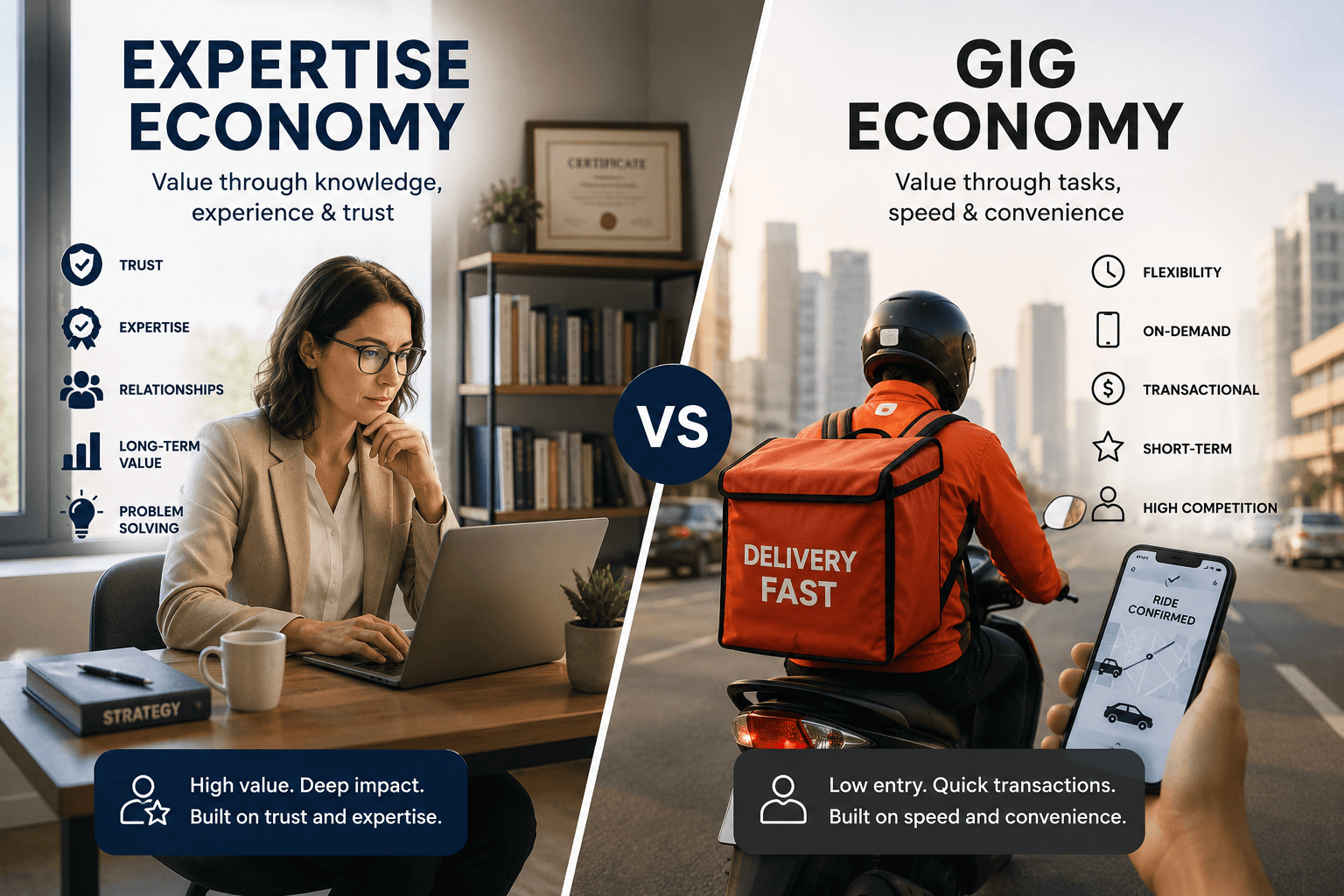
The gig economy is built on interchangeable labor sold by the task. Rideshare drivers, delivery couriers, handyman-marketplace workers, and generic freelance-platform writers are all selling a unit of time or a completed task — and that unit is largely interchangeable between providers.
A rider doesn't choose their driver by name. They choose "a driver, nearby, now." The platform sets the price, matches supply to demand, and takes a cut. Individual skill matters at the margins — a five-star rating helps — but the core offering is fungible. Any qualified worker can fulfill the request.
This is why gig income has a hard ceiling: hours available × rate per hour, with the rate set largely by the platform and the market, not by the individual worker's differentiation.
What is the expertise economy?
The expertise economy is built on specialized knowledge that isn't interchangeable — clients choose you specifically, not "a coach, nearby, now." A therapist's approach, a coach's framework, a consultant's specific experience in a niche — these are the product, and they can't be swapped for the next available provider without losing something real.
This is what allows expertise economy professionals to price based on outcome and depth rather than time. A six-session container that gets a client through a career transition isn't priced by the hour — it's priced by the transformation. That's a fundamentally different pricing logic than "task completed, next please."
Where does the confusion come from?
The confusion is structural. Both gig workers and expertise professionals are self-employed, both invoice directly, both lack the safety net of a salaried job, and both got folded into the same "future of work" narrative over the past decade. Platforms reinforced it — many freelance marketplaces host a graphic designer taking $20 logo jobs and a business coach charging $300 a session under the same "freelancer" umbrella.
The result: many coaches and therapists absorb a gig-worker mindset without noticing. They price by the hour because that's "how freelancers price." They take whichever client shows up next because that's "how gig work goes." They never build packages, programs, or products — because the gig platforms they're modeling themselves on don't have packages either. You just take the next ride.
What are the core differences?
| Dimension | Gig Economy | Expertise Economy |
|---|---|---|
| Core unit sold | A task or a ride | A transformation or outcome |
| Interchangeability | High — any qualified worker fulfills it | Low — clients choose a specific practitioner |
| Pricing basis | Platform-set rate per task | Practitioner-set price based on value |
| Income ceiling | Hours available × rate | Packages, programs, and products beyond hours |
| Client relationship | One-off, transactional | Ongoing, relationship-based |
| Who sets the price | The platform | The practitioner |
Why does gig-style pricing cap your income?
If you price and structure your practice like gig work, you inherit its ceiling — even though your actual business doesn't have one. A coach charging $100 per session, one at a time, with no packages, is running a gig-economy pricing model on top of an expertise-economy product. That mismatch is exactly where income gets stuck.
Run the numbers: 20 single sessions a week at $100 each is $8,000 a month — a hard ceiling set entirely by your calendar. The same 20 slots, sold as 4-session packages with a course and a handful of digital products layered on top, can produce meaningfully more from the same number of hours, because some of that revenue no longer depends on a session happening in real time.
The tell is usually the same: no packages, no programs, no products — just single sessions, booked one at a time, priced identically regardless of the client's stage or the depth of the relationship. That's rideshare pricing applied to a business that could support several times the revenue per client.
How do you price like an expertise economy professional?
Three shifts separate expertise pricing from gig pricing.
- Price the outcome, not the hour. A client isn't paying for 50 minutes — they're paying for the results those 50 minutes, repeated over time, produce. Package your sessions accordingly.
- Make your differentiation visible. Your specific approach, your specific results, your specific voice — put that at the center of how you market and price, instead of competing on availability the way a gig platform would.
- Add income that doesn't require another shift. Courses, group programs, and digital products let your expertise earn without you personally delivering every unit of it — something no gig platform offers its workers.
None of this means abandoning session-based work. Sessions are often the highest-trust, highest-value part of an expertise business. It means recognizing that the pricing logic underneath a gig platform and the pricing logic underneath your practice should never have been the same one.
If you're ready to structure your practice with packages, programs, and products instead of one-at-a-time gig pricing, see what coaching software built for the expertise economy looks like.
Frequently asked questions
Is coaching a gig economy job?
No — not in the economic sense, even though coaches are independent contractors the same way gig workers are. Gig work sells interchangeable labor by the task; coaching sells a specific practitioner's expertise and relationship, which isn't interchangeable. The tax status looks similar. The underlying economics aren't.
What's the main difference between gig work and expertise work?
Gig work is priced by a platform for an interchangeable task — any qualified worker can fulfill it. Expertise work is priced by the practitioner for a transformation that depends on who is delivering it. That difference is why expertise businesses can charge for outcomes instead of hours.
Why do coaches and therapists underprice themselves like gig workers?
Because 'independent contractor' marketing blurs the two together. Many practitioners default to hourly, single-session pricing — the gig-economy model — even though their actual product, a relationship-based transformation, supports package and program pricing instead.
Can I be in the expertise economy while doing gig-style work on the side?
Yes. Plenty of practitioners drive for a rideshare app or take marketplace freelance gigs while building an expertise practice. The distinction matters for how you price and structure your coaching or therapy business specifically — not for what else you do to pay the bills while you build it.
How do I stop thinking like a gig worker and start pricing like an expert?
Start by replacing single sessions with packages, and price the package around the outcome a client is working toward — not the number of hours it takes. Then add one scalable offer, like a group program or course, that doesn't require you to personally deliver every unit.