
Key Takeaways
- The expertise economy is the movement of independent professionals who earn income from selling their knowledge, skills, and experience — not their hours.
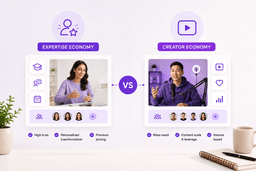
- Unlike the creator economy, it's built on depth and client relationships, not audience size or virality.
- Coaches, therapists, consultants, tutors, and trainers are all part of the expertise economy — most just don't have the infrastructure to scale beyond 1:1 sessions.
- The income ceiling in the expertise economy isn't your expertise — it's your business model.
- The platforms built for the creator economy don't fit the expertise economy. The tools that do fit are still catching up.
In this article
You've spent years developing knowledge that genuinely helps people. You have clients who trust you, results you can point to, and skills that took serious time to build. But you're still charging by the hour. And every hour you don't work is an hour you don't earn.
That's not a motivation problem. It's a business model problem. And it's the exact problem the expertise economy was built to solve.
What the expertise economy actually is
The expertise economy is the growing movement of independent professionals — coaches, therapists, consultants, tutors, trainers, instructors — who build income from their knowledge and skills, not just their time. It's the shift from "I charge for my hours" to "I charge for the transformation I create."
The key distinction: in the expertise economy, your income doesn't have to stop when you stop working. When you sell a course, a digital guide, or a recorded program, that revenue exists whether you're in a session, on a walk, or asleep. The expertise is still being delivered — just not through you, live, in real time.
This isn't a new idea. Experts have always written books, taught classes, and built programs. What's new is that the internet removed the barriers: you don't need a publisher, a classroom, or a studio. You need the right infrastructure and the right offer.
How does it differ from the creator economy?
The creator economy and the expertise economy are often used interchangeably. They're not the same thing.
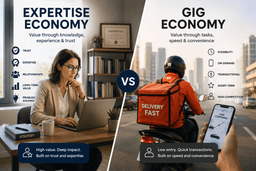
The creator economy is built on content and audience size. The expertise economy is built on depth of knowledge and client relationships.
A YouTuber with 500,000 subscribers earns through ad revenue, brand deals, and merchandise — all dependent on reach and engagement. A life coach with 80 committed clients earns through sessions, packages, a course, and a group program — all dependent on trust and results. The YouTuber is in the creator economy. The life coach is in the expertise economy.
Here's why this distinction matters for you: the tools built for the creator economy don't work for expertise economy professionals. You don't need a way to grow an audience and monetize content. You need a way to book sessions, protect your income, and sell programs — to the people who already trust you.
Who is part of the expertise economy?
If you have knowledge that other people pay for, you're in the expertise economy. That includes:
- Life coaches and business coaches — selling sessions, packages, courses, and group programs
- Therapists in private practice — running individual sessions, group programs, and psychoeducation content
- Consultants — advising businesses and professionals on specific domains
- Tutors and educators — structured one-to-one and group teaching
- Fitness and wellness trainers — movement programs, nutrition courses, habit coaching
- Instructors and facilitators — running workshops, live programs, and skill development courses
What connects them: they're all selling a structured transformation — not their labor as a commodity, and not content for a passive audience to consume.
What does income look like in the expertise economy?
Most expertise economy professionals start with the same model: one-to-one sessions, charged by the hour or the session. That model works. But it has a ceiling — you can only run so many sessions per week, and every hour you're unavailable is revenue you can't recover.
The expertise economy opens four income streams beyond the hourly session:
- Session packages and bundles — clients commit to a block of sessions upfront, which increases retention and reduces the scheduling overhead of rebooking every week.
- Online courses — recorded programs that teach a specific transformation. Clients access them on their own time. You record them once.
- Live group programs — cohorts, workshops, and multi-week programs that serve multiple clients simultaneously. Your expertise is delivered once; the revenue is multiplied.
- Digital products — guides, workbooks, templates, and frameworks that clients purchase and use independently.
The most sustainable expertise economy businesses combine all four. Sessions for high-touch clients. Courses for those who can't afford 1:1 time or who prefer self-paced learning. Group programs for the cohort model. Digital products for passive income that builds over time.
What infrastructure do you actually need?
This is where most expertise economy professionals get stuck. They have the knowledge. They have the clients. But their setup involves four or five tools that don't talk to each other — Calendly for booking, Kajabi or Teachable for courses, Gumroad for products, a separate website, and a spreadsheet to track everything.
The cobbled-together tech stack is the most common reason expertise economy professionals can't scale. Every handoff between tools creates friction — for you and for your clients. A client who has to visit three different platforms to book, learn, and buy is a client who often doesn't.
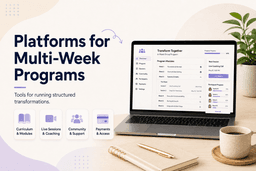
The infrastructure an expertise economy business actually needs:
- Session booking with real scheduling, not just a link to a calendar
- Native cancellation policy and enforcement — not a note in the booking description
- Session packages and credit tracking built in
- A place to host and sell courses and digital products
- Live event and group program capability
- One client view — so you can see their bookings, purchases, and history in one place
- One page clients visit — not four different platforms depending on what they're doing
Most platforms cover one or two of these. Very few cover all of them. That gap is exactly what expertise economy professionals are hitting right now — and why the infrastructure question matters as much as the offer question.
Why is now the right moment to build in the expertise economy?
Three things converged in the last five years that make the expertise economy the best opportunity for independent professionals right now.
First, the pandemic normalized video sessions and online learning permanently. Clients who never considered working with a remote coach or therapist now prefer it. The geographic barrier between you and your potential clients is gone.
Second, the tools have caught up enough. Online course platforms, streaming infrastructure, and payment systems have made it possible to deliver a professional expertise business without a team or significant capital.
Third — and most importantly — the competition is still surprisingly thin. Most practitioners are still operating with the same patchwork of tools and the same hourly session model they started with. The practitioners who build the right infrastructure now will own the market position others are still figuring out.
The expertise economy isn't a trend. It's the direction of independent professional work. The question isn't whether to participate — it's whether you have the systems in place to participate properly.
If you're a coach or therapist ready to build the infrastructure side of your expertise business, see what expertise business software for coaches looks like in practice.
Frequently asked questions
What is the expertise economy?
The expertise economy is the growing movement of independent professionals — coaches, therapists, consultants, tutors, trainers, and instructors — who build income from their knowledge and experience, not just their hours. It's defined by expertise-based products: sessions, courses, programs, and digital products sold directly by the expert.
Is the expertise economy the same as the creator economy?
No. The creator economy is built on content, audiences, and reach — it rewards volume and virality. The expertise economy is built on depth, trust, and client relationships. A therapist with 50 committed clients is in the expertise economy. A YouTuber with 500,000 subscribers is in the creator economy. Different metrics, different income models, different tools.
Do I need a large audience to succeed in the expertise economy?
No. The expertise economy is one of the few places where a small, trusted audience is enough. A life coach with 100 loyal clients can build a sustainable income from sessions, packages, and courses without ever going viral. The model rewards depth, not reach.
What platforms are built for the expertise economy?
Most platforms are built for one part of the expertise economy — Calendly for booking, Teachable for courses, Gumroad for digital products. Merkora is built to cover the full model: sessions, packages, no-show protection, courses, live programs, and digital products from one place.
Can therapists participate in the expertise economy?
Absolutely. Therapists running private practices are expertise economy professionals — they sell structured knowledge and skills through sessions. Many also build diversifying products like psychoeducation courses, self-help guides, and group programs. The challenge is that most tools aren't designed for this combination.