
Key Takeaways
- Freelancing sells your time directly to one client at a time, invoiced by the hour or the project — the ceiling is set by your calendar.
- Expertise monetization sells your knowledge in formats — packages, courses, programs, products — that can serve more than one client per hour of your time.
- The two aren't different professions — most expertise monetization businesses start as freelancing and evolve from there.
- The clearest sign you're still freelancing: every dollar you earn this month required a matching hour this month.
- Moving from freelancing to expertise monetization doesn't require new skills — it requires packaging the skills you already have into repeatable, sellable formats.
In this article
A consultant has been freelancing for six years. Same hourly invoice model since day one, same client-by-client hustle, steadily raising her rate as she's gotten better. Her income has grown — but slower than her expertise has, and she can't quite explain why the two stopped moving together.
The answer is structural, not a lack of skill or effort: she's still running a freelance business, not an expertise monetization business. They look similar from the outside. They behave very differently once you look at how the income is actually built.
What is freelancing?
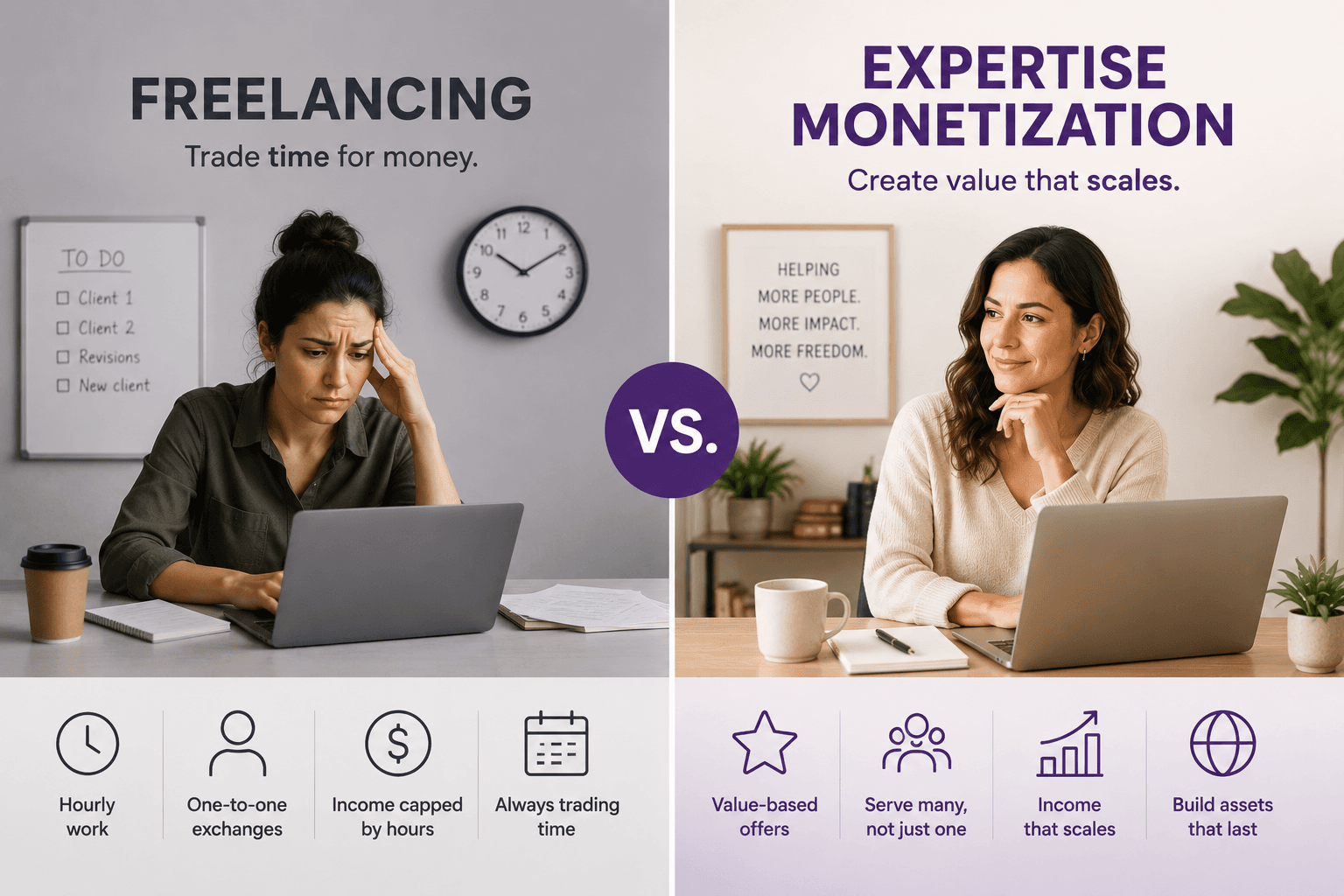
Freelancing is selling your time and skills directly to one client at a time, typically invoiced by the hour or the project. A freelance consultant, coach, designer, or writer takes on client work, delivers it personally, and gets paid for that specific engagement. The next dollar requires the next engagement.
Freelancing is a real and often excellent way to start an expertise business. It validates that people will pay for what you know, builds a client base and a track record, and teaches you what actually works — all before you invest in packaging anything.
What is expertise monetization?
Expertise monetization is selling your knowledge in formats that don't require a matching hour of your time for every dollar earned. Session packages sold upfront, courses built from your recurring client conversations, group programs that serve 8 people in the time it takes to serve 1, and digital products that sell independently of your calendar.
The knowledge underneath is often identical to what a freelancer already delivers. The difference is the format — and the format is what determines whether income scales with your reputation or stays capped by your hours.
What are the core differences?
| Dimension | Freelancing | Expertise Monetization |
|---|---|---|
| How income is earned | One client, one hour, one invoice at a time | Packages, programs, and products across many clients at once |
| Relationship to your calendar | Every dollar requires a matching hour | Some income is decoupled from hours worked |
| Growth lever | Raise your hourly rate or add more hours | Add formats that serve more people per hour |
| What's actually being sold | Your time and availability | Structured knowledge, delivered at different scales |
| Income during time off | None | Possible — courses and products keep earning |
Why does freelancing have a hard income ceiling?
Freelance income is bound by a simple equation: hours available × your rate. There are only so many hours in a week you can bill, and raising your rate has diminishing returns — past a certain point, clients balk, and the rate increase that once felt bold stops moving the needle.
A freelancer billing $150/hour for 25 billable hours a week is at roughly $15,000/month, full stop. To earn more, she needs more hours (finite), a higher rate (bounded by the market), or a different structure entirely. That third option is expertise monetization.
What are the signs you're still operating as a freelancer?
A few reliable signals show up across coaches, consultants, and therapists who are still fully in freelance mode, even if they don't think of themselves that way:
- Every dollar earned this month required a matching hour this month
- Taking time off directly and proportionally reduces income
- Pricing conversations happen client by client, with no standard packages
- There's no offer a client can buy without booking your calendar first
- A slow month for bookings is always a slow month for revenue
None of these are wrong or bad ways to run a business — many practitioners are genuinely happy freelancing indefinitely. But if the income ceiling is the actual complaint, these are the exact points where expertise monetization changes the equation.
How do you move from freelancing to expertise monetization?
The move doesn't require new expertise — it requires repackaging the expertise you already have. Three steps, in order:
- Convert your freelance sessions into packages. Sell a block of sessions upfront instead of billing one at a time. No new content required — just a different pricing structure.
- Run one group offering. Take the advice you repeat most often in individual engagements and deliver it live to 6–10 people at once, at a fraction of your 1:1 rate per person.
- Build one product from what you already do. A course, template, or guide based on your most common client engagement — something that can be sold without your live presence.
Most practitioners who make this shift keep freelancing for their highest-value 1:1 relationships and layer expertise monetization on top — not one or the other, but both, deliberately structured.
If you're ready to package your freelance expertise into something that scales, see what expertise monetization software for coaches looks like in practice.
Frequently asked questions
What's the difference between freelancing and expertise monetization?
Freelancing sells your time, one client and one hour at a time, invoiced after the fact. Expertise monetization sells your knowledge in packaged formats — session packages, courses, group programs, digital products — some of which can serve multiple clients from the same hour of work. Freelancing has a hard income ceiling set by your calendar; expertise monetization doesn't.
Can a freelancer become an expertise monetization business without hiring anyone?
Yes — this is how most expertise monetization businesses actually start. A solo freelance coach or consultant packages their existing service into a course or group program, still working alone, but earning from formats that don't require a 1:1 hour for every dollar.
Is freelancing a bad way to start?
No. Freelancing is often the fastest way to validate that people will pay for your expertise, build a client base, and learn what actually works before you package anything. The mistake is staying in pure freelancing indefinitely once you have that evidence.
What's the first product to build when moving beyond freelancing?
A package, not a course. Converting your existing freelance sessions into a paid package (e.g., 6 sessions sold upfront) requires no new content and immediately starts decoupling some of your income from single-session, single-hour billing.
Do I need an audience to move beyond freelancing?
No. Most freelancers moving into expertise monetization start by offering packages and group programs to clients they already have. An audience helps you grow faster later — it isn't a prerequisite for the first step.