Key Takeaways
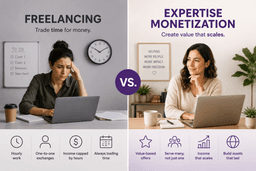
- Expertise monetization means building income streams from your knowledge beyond charging by the hour.
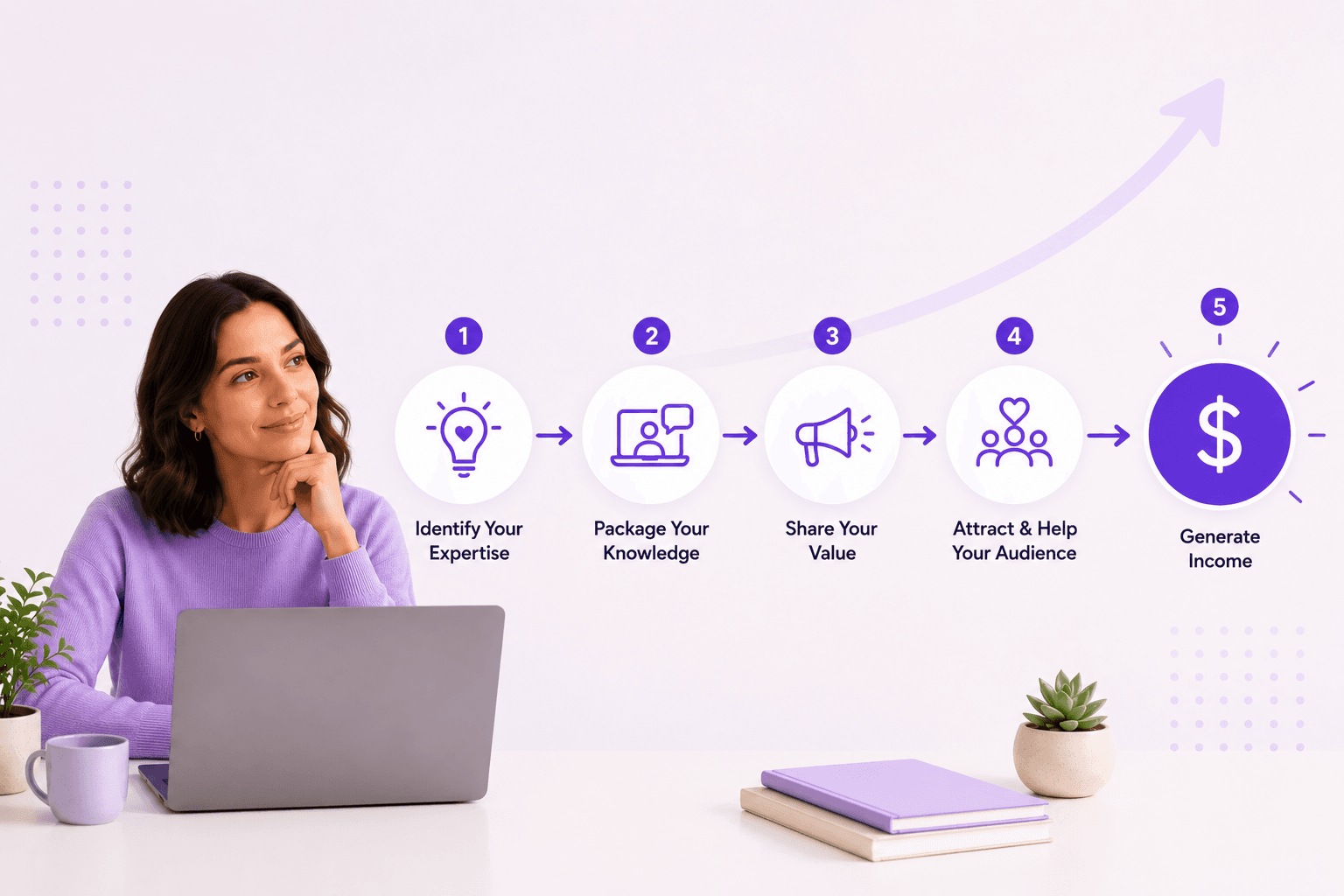
- The transition from 'selling time' to 'selling expertise' requires three things: a clear offer, the right format, and delivery infrastructure.
- Session packages are the fastest win — they stabilize income, reduce no-shows, and increase retention without extra marketing.
- Group programs multiply your hourly revenue without increasing your hours — serving 6–10 clients at once instead of one.
- You don't need to start with everything. Pick one income stream, do it properly, and add the next once the first runs itself.
In this article
Most coaches and therapists start the same way: they offer sessions, charge by the hour, and build a practice one client at a time. This works — up to a point. The point where it stops working is when your schedule is full and there's no way to earn more without adding more hours.
Expertise monetization is the answer to that constraint. Here's how to actually do it — one step at a time, starting with what you already have.
What's the difference between selling time and selling expertise?
When you charge $150 for a 50-minute session, you're selling time. You're there; you're paid. You're not there; you earn nothing. The ceiling is fixed by the number of hours in your week.
When you sell your expertise, you sell the transformation — packaged in a format that doesn't require you to be present for every delivery. A course that teaches what you cover in every intake session. A group program where 10 clients receive the same guidance simultaneously. A digital workbook that clients complete between sessions. Each of these is your expertise, delivered at scale.
The transition doesn't mean abandoning 1:1 sessions. Most practitioners who succeed with expertise monetization keep a core session practice for their highest-touch, highest-value clients — and layer scalable products on top for clients who need less intensity or can't afford the 1:1 rate.
Step 1 — package what you already sell
Before building anything new, convert your existing sessions into packages. A package is a block of sessions sold upfront — typically 4, 6, or 10 sessions, at a modest discount for the commitment.
This is the fastest, lowest-effort form of expertise monetization available to any practitioner. No new content to create. No new platform to learn. Just a different way of pricing what you're already doing.
Packages stabilize your income, reduce no-shows, and increase client retention — all at the same time. A client who buys a 6-session package has already paid. They're committed to the process. They're far less likely to cancel or ghost. And because they're in a structured arc, you're more likely to see the results that lead to referrals.
The mechanics: set your package size and price, track credit usage (so you know when a client has 1 session remaining), and make it clear this is the primary way new clients engage with you. Make single sessions available but position packages as the default. The right booking system handles credit tracking automatically — you shouldn't be maintaining a spreadsheet for this.
Step 2 — run a live group program
A group program is the highest-leverage expertise monetization available to practitioners: you deliver your knowledge to 6–12 clients simultaneously, each paying a fraction of your 1:1 rate, generating more revenue per hour than any individual session.
A coach who charges $200/hour, running an 8-person group at $80/person/session, earns $640/hour instead of $200 — while creating group dynamics that often enhance the experience for participants.
Start with a 4-week program on a topic you cover repeatedly in 1:1 sessions. Announce it to your existing client list first — these are people who already trust you and know your work. Price it at 30–50% of what 4 individual sessions would cost. Fill 6–8 spots. Deliver it live over video. Record the sessions.
After the first run, you have client feedback, real examples and questions from the group, and recordings you can use as the foundation for a course. The group program is the fastest path to course content that actually works.
Step 3 — build a course from your live content
Once you've run a group program or workshop — and have the recordings, the questions, the feedback — you have most of what a course needs. The remaining work is editing, structuring, and making it self-contained enough that someone can go through it without live instruction.
The advantage of building a course this way is that you already know it works. The content was tested with real people who had real questions. The gaps you filled during live Q&A become the clarifying sections in the course. The results your group participants got become the social proof.
Course pricing: most practitioners price their first course between $97 and $497. A course that covers the same ground as 3–4 individual sessions can justify $200–$300. A comprehensive program that creates a major outcome over 8 weeks can justify $500 or more.
Once a course is built and generating passive sales — even at modest volume — it becomes a reliable income stream that runs independently. You update it once a year. It earns while you're in sessions.
Step 4 — add digital products as passive income
Digital products — workbooks, guides, templates, assessment tools, frameworks — are the lowest price point and the fastest to create. They typically sell for $15–$99 and require zero delivery from you once created.
For practitioners, digital products serve a dual purpose: they generate income from people who aren't yet ready for 1:1 sessions, and they build the trust that converts those people into future clients.
The easiest digital product to create is a structured version of something you already give clients for free. A worksheet you use in every intake session. A self-assessment tool you've developed over time. A guide you email to clients after their first session. Package that into a clean PDF, price it at $29–$49, and add it to your practice page.
Digital products compound. One product earning $200/month doesn't change your practice. Three products earning $200/month each adds $600/month without a single additional session.
How do you sequence this without burning out?
The mistake most practitioners make is trying to do everything at once — launch a course, start a group program, create digital products, build a website, grow on social media. The result is burnout and nothing actually launched.
The right sequence: one income stream at a time, each added only after the previous one is running smoothly.
- Month 1–2: Convert existing clients to packages. Make this your default offering.
- Month 3–4: Run one live group program. Keep it small. Deliver it well. Record it.
- Month 5–6: Turn the group recordings into a self-paced course. Set it up for passive sales.
- Month 7+: Create one digital product. Add it to your practice page.
At the end of this arc, you have four income streams — sessions, packages, a course, and digital products — built one at a time, each reinforcing the next. The expertise was always there. The difference is the infrastructure to deliver it properly.
If you want to see what that infrastructure looks like in one platform, see how expertise monetization software for coaches handles sessions, packages, courses, and products in one place.
Frequently asked questions
What is expertise monetization?
Expertise monetization is building income from your knowledge, skills, and experience beyond hourly sessions. It includes session packages, online courses, group programs, live events, and digital products. For coaches and therapists, it's the shift from 'I charge for my time' to 'I charge for the transformation I create — in multiple formats.'
How do I start monetizing my expertise without a large audience?
Start with what you have — your existing clients. Offer current clients a session package instead of single sessions. Once packages are running, use that committed client base to launch a first group program. Most practitioners don't need more audience; they need better offers for the people already working with them.
How much should I charge for expertise products?
Price based on the value of the outcome, not the cost of your time. A 6-session coaching package should be priced at a small discount to 6 individual sessions — enough to reward the commitment, not so much that it erodes your session rate. Courses should be priced based on what transformation they create, not how long they took to produce.
Is it possible to build passive income as a therapist?
Yes, though most therapy is relationship-intensive and can't be fully automated. Therapists in private practice can add passive income through psychoeducation courses, workbooks and guides, and group programs that serve multiple clients simultaneously. These supplement 1:1 sessions rather than replace them.
What tools do I need to monetize my expertise?
At minimum: a session booking system with packages, a way to host courses and digital products, and live event infrastructure for group programs. In practice, most practitioners patch together 3–5 separate tools for this. The more efficient approach is a platform that handles all of it — so your clients access everything from one place.