Key Takeaways
- Multiple income streams don't require multiple skills — they require repackaging the same expertise into different formats for different types of clients.
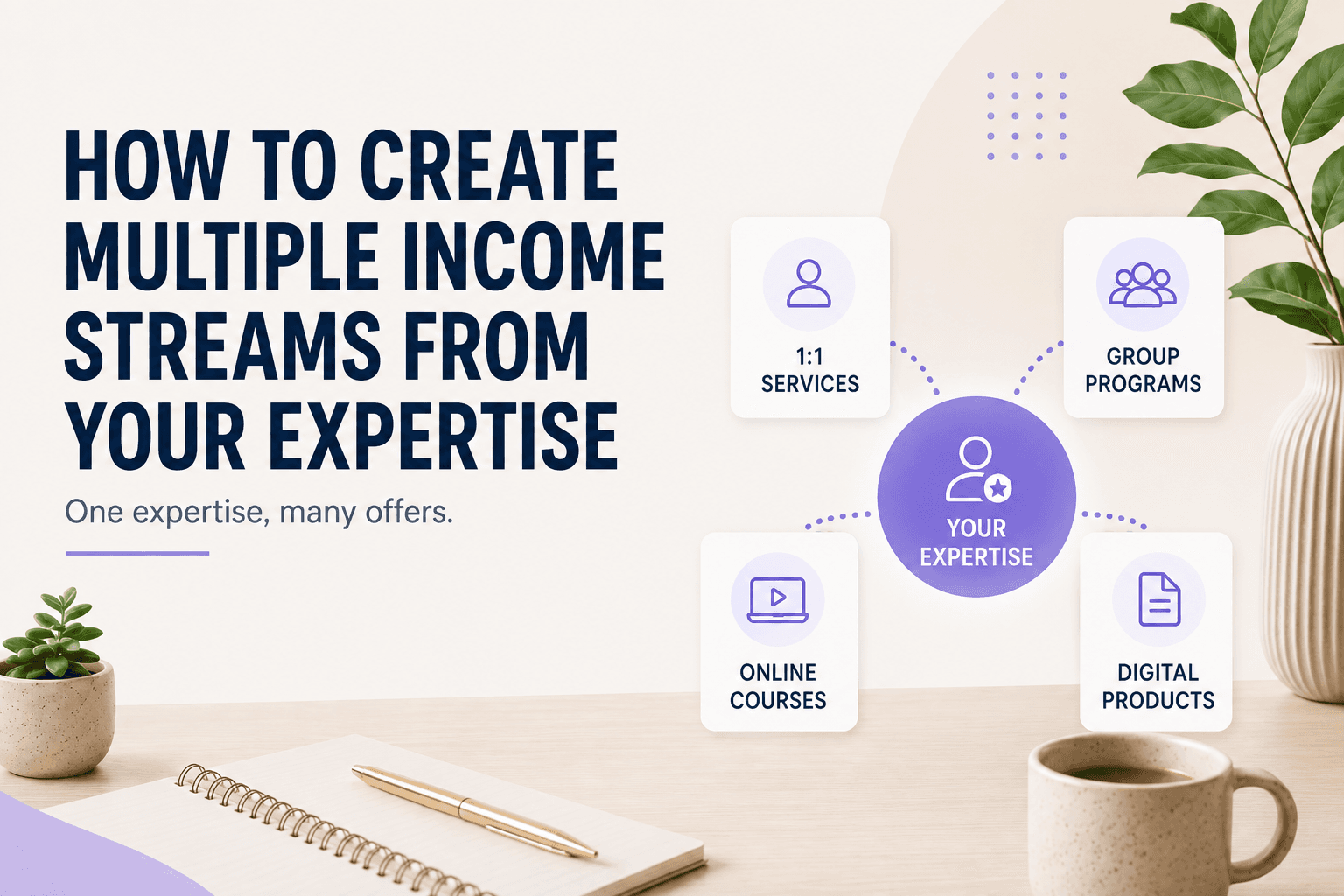
- The four streams that consistently work for coaches and therapists: 1:1 sessions, session packages, courses or digital products, and live group programs.
- Each stream should feed the others — sessions build the trust that sells a course, a course reaches people who later want 1:1 access.
- Build in order of proof, not ambition: validate with sessions first, then add packages, then a scalable format built from what sessions already taught you clients need.
- The operational risk isn't picking the wrong streams — it's running each one through a different tool, which turns diversified income into fragmented admin.
In this article
"Multiple income streams" gets talked about like it means multiple businesses — as if a therapist adding a course needs to become a course creator on top of being a therapist. That's not what actually works, and it's not what the practitioners who've done this successfully actually did.
Real income diversification for an expert isn't about doing more different things. It's about packaging the one thing you're good at into a few different formats, each serving a different kind of client.
One expertise, not multiple businesses
Every income stream you build should come from the same underlying expertise — not from learning something new to sell. A career coach's income streams — sessions, a package, a course on interview preparation, a group program for job seekers — are all the same knowledge, delivered differently. None of them require the coach to develop a new skill set. They require deciding which format fits which client's situation.
This distinction matters because "learn a new skill to diversify income" is exhausting and often never happens. "Repackage what I already know how to do" is achievable in weeks, because the hardest part — actually knowing the material — is already done.
What are the four streams actually worth building?
Individual sessions, session packages, a course or digital product, and live group programs — in that rough order of how most practitioners build them.
- Individual sessions — your highest-price, highest-trust offer, for clients who want direct 1:1 access
- Session packages — the same sessions, sold as a committed bundle, improving retention and cash flow
- A course or digital product — built from what you already teach repeatedly, priced for people who can't or won't pay for 1:1 time
- Live group programs — cohorts or workshops that deliver your expertise to several people at once, priced between 1:1 sessions and a fully passive product
Not every practitioner needs all four immediately. But each one solves a different limitation of the stream before it — packages solve session unpredictability, products solve the time ceiling, group programs solve the gap between fully passive and fully 1:1.
How do these streams reinforce each other?
Each stream feeds the next — sessions build the trust that sells a course, and a course reaches people who eventually want direct access to you. A client who takes your course and gets real value from it is a warmer lead for 1:1 sessions than a cold visitor ever would be — they've already experienced your teaching and trust it works. Meanwhile, session clients are the best source of proof for what your course or group program should actually contain, because you're hearing their real questions every week.
This is why treating income streams as separate businesses is a mistake — they're not competing for the same client. They're catching different people at different points of readiness, and moving them toward each other over time.
Pro tip
What order should you actually build these in?
Build in order of proof, not ambition — validate each stream with real demand before investing time in the next one. Start with sessions, because they're the fastest way to get paid and the fastest way to learn what clients actually need. Add packages once you have consistent repeat demand — they're a small operational change with an immediate cash-flow benefit. Only then build a course or group program, using the patterns from your sessions as the actual content outline.
Building a course before you've run sessions on the topic means guessing at what to include. Building it after means you're recording an answer you've already given successfully, multiple times, to real clients.
What actually holds multiple streams together?
Not strategy — most practitioners have a reasonable sense of what streams to build. The failure point is running each stream through a separate, disconnected tool. Sessions in a booking tool, a course on a course platform, payments split across both, no shared client record — that setup turns "multiple income streams" into "multiple systems to manage," and the admin overhead is often what actually kills a second or third stream, not lack of demand.
A single system where sessions, packages, courses, and client history live together means adding a new stream is a configuration decision, not a new tool subscription and a new login to manage.
Where this connects
This structure builds directly on the knowledge monetization ladder — sessions, courses, products — the same underlying idea, framed around the specific goal of diversified income rather than the packaging sequence itself.
Coaching software that supports sessions, packages, courses, and live programs in one place is what makes running several income streams sustainable rather than exhausting. Merkora was built specifically so adding a second or third income stream doesn't mean adding a second or third piece of software.
Frequently asked questions
What are realistic income streams for a coach or therapist?
The four that consistently work are individual sessions, session packages, an online course or digital product, and live group programs or workshops. All four come from the same underlying expertise — they differ in format and price, not in what you actually know.
Do I need to build all four streams at once?
No. Most practitioners start with sessions, add packages once demand is consistent, then build a course or group program from the patterns they've noticed across clients. Building all four simultaneously usually means none of them get done well.
Will adding a course reduce demand for my sessions?
Rarely. A course typically serves people who wouldn't have booked a session anyway — different budget, different readiness, different learning preference. It expands who you can serve rather than competing with your highest-value offer.
What's the biggest obstacle to running multiple income streams?
Usually operational fragmentation — sessions booked through one tool, a course hosted on another, payments split across both. That fragmentation creates enough admin overhead that many practitioners abandon a second income stream not because it didn't work, but because managing it wasn't worth the friction.