
Key Takeaways
- Most experts stuck at 1:1 sessions aren't short on ideas for what else to build — they're short on time and a low-risk way to start.
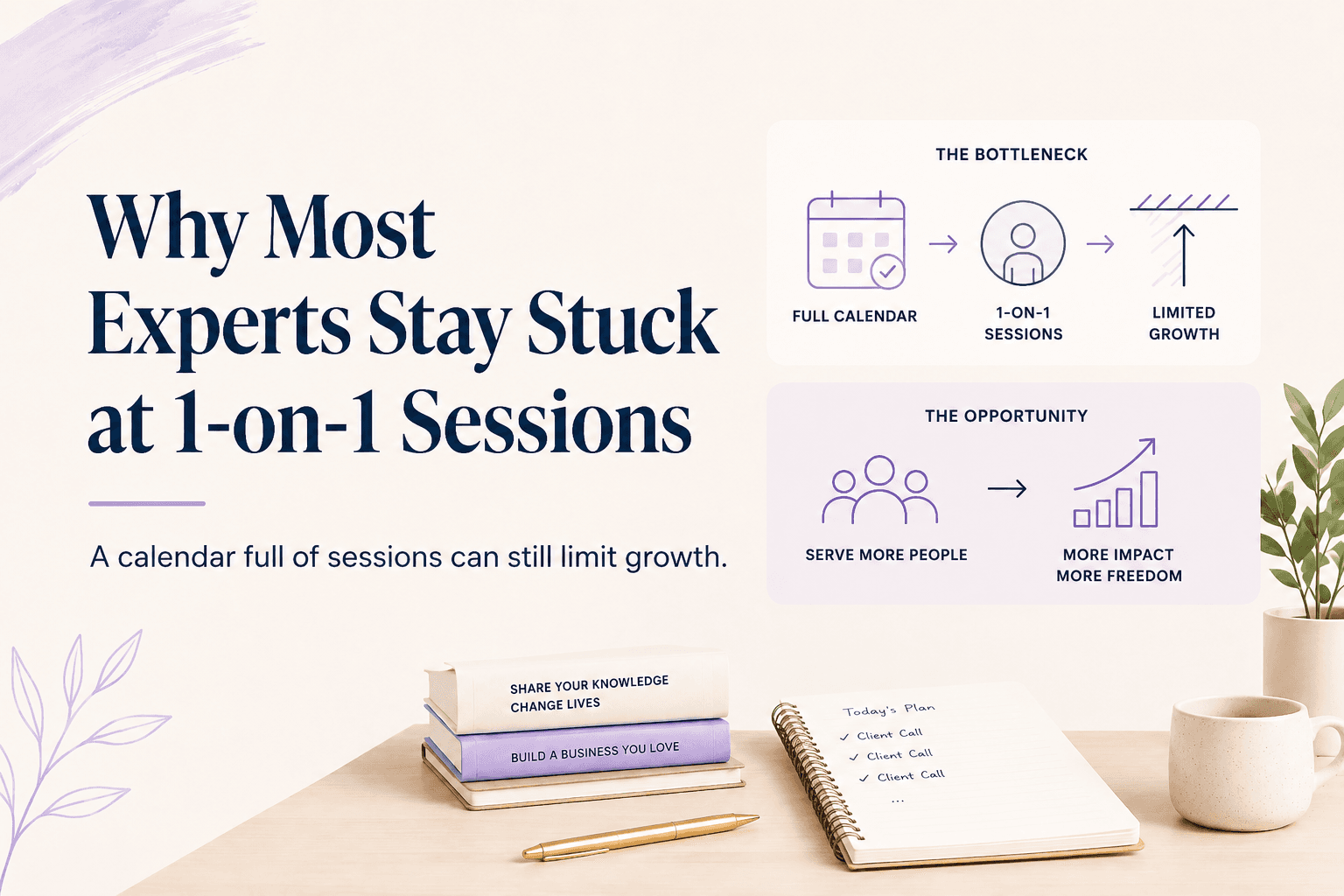
- A fully booked calendar leaves no slack to build anything new, which is precisely the situation that most needs a second income format.
- Without a small, low-risk first step, moving beyond sessions gets framed as a big project competing with an already-full calendar — and loses.
- "Just build a course" is bad advice for someone with no slack — it assumes free time and energy that a fully booked practitioner doesn't have.
- What actually works is a smaller first step than most people assume, taken from inside the existing client relationship rather than as a separate project.
In this article
Almost every practitioner who's been in practice for a few years has, at some point, thought about building a course, a program, or some product beyond their sessions. Very few actually do it. The gap between "I should build something" and "I built something" is wide, and it's rarely explained by the reason most people assume.
It's rarely a lack of ideas
Ask a practitioner stuck at 1:1 sessions what they'd build if they had time, and most have an answer immediately — often a good one, based on something they explain to clients repeatedly. The idea isn't the missing piece. Something else is.
The real blocker: no slack in the calendar
A fully booked calendar leaves no room to build anything new — and being fully booked is exactly the situation that makes a second income format most necessary. That contradiction is the actual trap: the busier and more successful the 1:1 practice gets, the less time there is available to build the thing that would relieve the pressure it's creating.
This isn't a discipline problem. It's a genuine resource constraint — there's no version of "just find the time" that works when every hour is already committed to paying clients.
The second blocker: no low-risk first step
Even practitioners who do find some slack often stall because the next step feels large and uncertain — build a whole course, launch a program, restructure the business. Facing a big, ambiguous project against a calendar that's already full, most people reasonably choose to keep doing what's reliably working instead.
The actual first step, covered in transitioning from hourly billing to expertise monetization, is much smaller than that — but it's not the step most people picture when they imagine "building something new."
Why "just build a course" makes it worse
This is the most common advice given to stuck practitioners, and it's usually the wrong first move. Building a full course is a real project — hours of planning, recording, and structuring. Telling someone with zero calendar slack to take that on, without first freeing up any time or validating demand, sets them up to stall exactly where they already are.
Important
What actually gets experts unstuck
The move that works is smaller and requires no new time: converting a few willing existing clients from single sessions to a package. It changes how the work is sold and paid for, not what the work is — no new content, no new hours, and it immediately improves cash flow and retention.
From there, the path opens naturally — tracking what gets repeated across clients becomes the shortlist for scaling beyond 1:1 sessions once there's actual room to build it.
Merkora keeps that first step low-effort — packages, courses, and programs live on the same platform as your existing sessions, so the smallest possible first move doesn't require adopting a second tool to take it.
Frequently asked questions
Is being stuck at 1:1 sessions usually a mindset problem?
Not primarily. It's more often a structural problem — no time in the calendar to build something new, and no obvious small first step. Mindset framing tends to blame the practitioner for a scheduling and sequencing problem.
Why does 'just build a course' not work as advice?
Because it assumes spare time and energy that a fully booked practitioner doesn't have. Building a full course is a real project — telling someone already at capacity to take it on without freeing up time first sets them up to stall.
What's a realistic first step for someone who's fully booked?
Converting a few willing existing clients from single sessions to a package. It requires a conversation, not new content, and it's the same first move covered in transitioning from hourly billing to expertise monetization.
How do I find time to build something new if my calendar is already full?
Look for the smallest possible first step that doesn't require new time — like converting current clients to packages — before looking for a step that requires carving out hours you don't have.