Key Takeaways
- Being excellent at your craft has a ceiling — at some point, revenue stops growing with skill and starts depending on your systems instead.
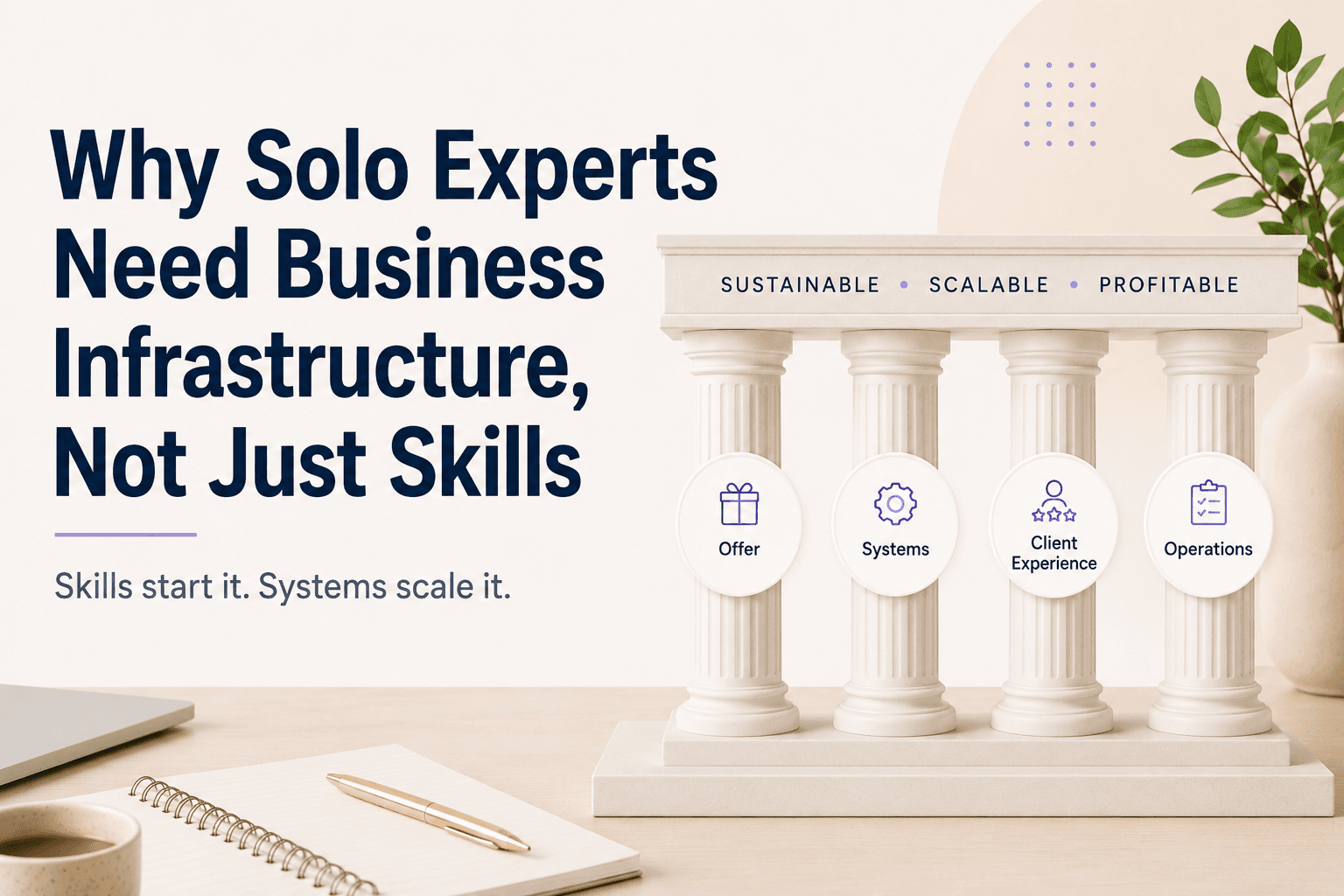
- 'Infrastructure' means the operational layer around your expertise: booking, payment, packages, cancellation enforcement, and a way to sell beyond 1:1 time.
- Most solo experts respond to hitting a plateau by trying to get better at their craft, when the actual constraint is operational, not skill-based.
- The most common missing pieces are a way to sell commitment (packages) instead of single sessions, and a way to earn without trading additional hours (courses or digital products).
- Adding infrastructure doesn't mean becoming a tech company — it means using one connected system instead of running the business through willpower and spreadsheets.
In this article
A therapist with a fully booked practice and a decade of experience is, by any craft measure, excellent at their job. And yet their income this year will look almost identical to last year's — not because they got worse, but because there are only so many hours in a week, and every one of them is already spoken for.
This is the ceiling that skill alone cannot break through. Getting better at your craft stops producing more income once your calendar is full. What produces more income past that point isn't more expertise — it's infrastructure.
What is the skill ceiling, exactly?
The skill ceiling is the point where your income stops scaling with your ability and starts scaling only with the hours you personally show up. Below that ceiling, getting better genuinely helps — you can charge more, attract better referrals, work more efficiently. Above it, none of that matters, because the constraint isn't your ability anymore. It's the number of sessions that fit in a week.
Most solo experts hit this ceiling earlier than they expect, often within a year or two of building a full practice. And most respond to it the wrong way — by trying to become even better at the craft, when the actual bottleneck has already moved somewhere else.
What does "infrastructure" actually mean here?
Infrastructure is the operational layer that lets your expertise generate income without requiring your direct, live involvement every single time. Concretely: automated booking and reminders that don't need you to manage a calendar manually, an enforced cancellation policy that doesn't rely on an awkward conversation, session packages that improve retention without extra admin, and a course or digital product that sells while you're not working.
None of this is about becoming a "tech person." It's about the difference between a business that requires your constant manual intervention to function and one that runs with systems doing the repetitive parts.
Why doesn't more skill fix an operations problem?
Because skill and operations solve different constraints — and once you've hit the operational ceiling, no amount of additional expertise removes it. A coach who becomes a genuinely better coach still can't run more sessions than fit in their calendar. A therapist with a stronger clinical toolkit still loses the same amount of time to manually tracking who's used their package sessions, or manually chasing a no-show fee.
The mistake is treating a plateau in income as a signal to invest more in the craft, when the actual signal is that the business has outgrown its own operations. Those are different problems, and they require different fixes.
Key takeaway
What infrastructure are most solo experts actually missing?
Two things show up most consistently:
- A way to sell commitment, not just single sessions — packages with tracked credits improve both cash flow and retention, but most solo practitioners still book and invoice one session at a time.
- A way to earn beyond hours worked — a course, a digital guide, or a recorded program that sells independently of your calendar, built from knowledge you already deliver repeatedly in sessions.
Both are achievable without hiring anyone or becoming a different kind of business. What they require is a system that handles the mechanics automatically — because manually managing packages and separately hosting a course is enough extra admin to make most practitioners give up before they get real traction on either.
What actually changes once infrastructure is in place?
The ceiling moves from "hours available" to "value delivered," which is a fundamentally larger number for anyone with real expertise. A practitioner with packages, automated cancellation enforcement, and one scalable product isn't working more hours than before — they're generating more income per hour already worked, plus income that doesn't require an hour at all.
This is also, practically, less stressful — not more. Fewer manual invoices, fewer awkward cancellation conversations, fewer spreadsheets tracking who owes what. The infrastructure doesn't add complexity to a solo practice. It removes the complexity that was already there, just being handled manually.
Building the infrastructure without becoming a tech operation
This doesn't require assembling a stack of specialized tools — that path recreates the same operational burden in a different form. It requires one system that handles booking, packages, cancellation policy, and course hosting together. Our piece on how to start an expertise-based business covers the earlier stage of this same problem — validating the offer before building infrastructure around it.
Therapist software or coaching software built around this exact gap — packages, enforcement, and scalable offers in one place — is what Merkora exists to provide, so the ceiling you hit is the market's, not your own admin.
Frequently asked questions
Why do skilled experts still struggle to grow their income?
Because income for a solo practitioner is capped by hours available, not by skill. Once your calendar is full, getting better at your craft doesn't create more hours in the week — it just makes each hour slightly more valuable. Real growth beyond that point requires infrastructure that doesn't depend on your time.
What does 'business infrastructure' mean for a solo coach or therapist?
It means the systems that run the operational side of the business without your constant manual involvement — automated booking and reminders, enforced cancellation policies, session packages with credit tracking, and a way to sell courses or digital products alongside live sessions.
Isn't building infrastructure a distraction from doing the actual work?
It can be, if you build it prematurely. But once you're spending meaningful time on manual scheduling, invoicing, and tracking client packages by hand, that admin work is already a distraction from the actual work — infrastructure removes it rather than adding to it.
What's the first piece of infrastructure a solo expert should add?
Usually session packages with automatic credit tracking. Moving clients from paying per session to committing to a package upfront improves both retention and cash flow, and it's typically the highest-leverage change before considering courses or group programs.